By Azura · Updated June 2026 · Raised Garden Hub is reader-supported. When you buy through links on our site, we may earn an affiliate commission at no extra cost to you.
The dirty secret of raised bed gardening: the soil costs more than the bed. A single 4×8 bed at 18 inches deep needs about 48 cubic feet of fill — a more common 12-inch-deep 4×8 needs about 32 cubic feet. Buying that all as bagged mix gets expensive fast. Here’s how to fill one smartly, for much less, without cheating your plants out of what they need.
Rule of thumb: Only the top 8–12 inches needs premium soil. Everything below that can be cheaper organic filler that breaks down over time.
How Much Fill Does Your Bed Actually Need?
Before you spend a dollar, do the math. Multiply length × width × depth (in feet) to get cubic feet.
| Bed size | 6-inch depth | 12-inch depth | 18-inch depth |
|---|---|---|---|
| 4×4 | 8 cu ft | 16 cu ft | 24 cu ft |
| 4×8 | 16 cu ft | 32 cu ft | 48 cu ft |
| 4×12 | 24 cu ft | 48 cu ft | 72 cu ft |
A standard 1.5-cubic-foot bag of garden mix fills very little of a deep bed. For a 4×8 at 12 inches you would need more than 21 bags — and that adds up to $150–$200 fast. See our soil calculator to run the numbers for your exact bed.
For a deeper look at sizing math, see how much soil a 4×8 raised bed needs.
The Layered Fill Strategy (Spend Less, Grow More)
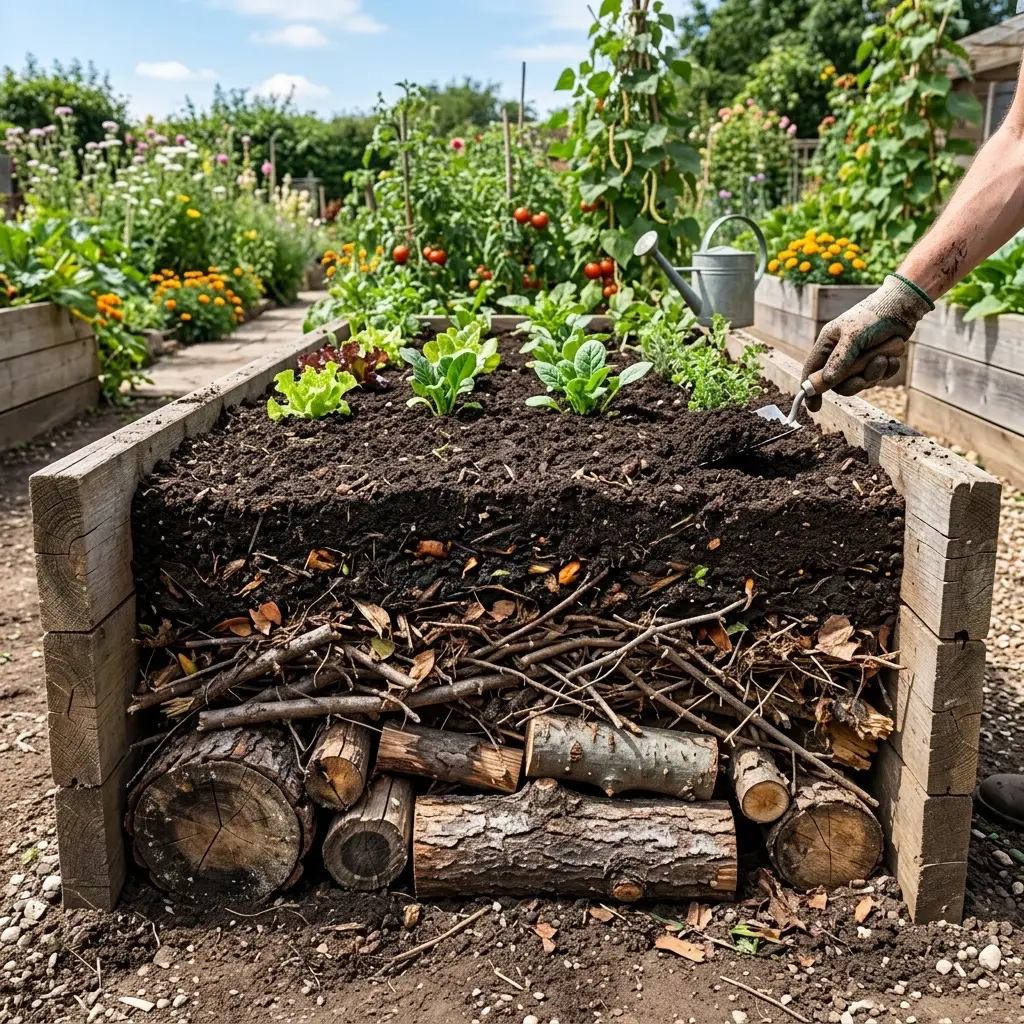
The core idea: bulky, cheap organics go on the bottom; quality growing mix goes on top. Your plant roots stay in the top 8–12 inches anyway during the first season — so that is where your budget belongs.
Think of it in three zones:
- Bottom zone (lower 30–50% of depth): free or cheap bulking material — logs, branches, wood chips, cardboard
- Middle zone (next 20–30%): compostable materials — leaves, straw, grass clippings, kitchen scraps, aged manure
- Top zone (top 8–12 inches): quality growing mix your plants actually root into
For a full breakdown of what goes where, see what to put at the bottom of a raised garden bed.
Method 1: Hugelkultur (Best for Deep Beds)
Hugelkultur is the practice of burying logs and woody debris at the base of a garden bed. As the wood decomposes, it acts like a slow-release sponge — holding water and releasing nutrients over several years.
How to do it:
- Lay logs and large branches directly on the ground inside the bed. Hardwoods (oak, maple, fruit trees) are ideal.
- Fill gaps with smaller sticks, twigs, and wood chips.
- Add a layer of compost or aged manure over the wood.
- Top with your premium growing mix (see below).
Pros: dramatically reduces the amount of purchased soil needed, improves water retention in dry seasons, self-fertilizing over time.
Cons: the bed will sink 2–4 inches as wood compresses in year one. Plan to top up with compost each spring.
Avoid wood from black walnut, eucalyptus, or any pressure-treated lumber — these can release compounds that suppress plant growth.
For a complete walkthrough of this method, see our hugelkultur raised bed guide.
Method 2: Lasagna Layering (Best for Shallower Beds and Yard Waste)
Lasagna layering — also called sheet composting — alternates “brown” carbon-rich materials with “green” nitrogen-rich materials. You are essentially building a compost pile inside your bed, then planting into the top.
How to do it:
- Start with a layer of cardboard directly on the ground (this smothers weeds and grass underneath).
- Add browns: dry leaves, straw, shredded newspaper, paper bags.
- Add greens: kitchen scraps, fresh grass clippings, coffee grounds, aged manure.
- Repeat alternating layers until you are 4–6 inches from the top.
- Finish with your premium growing mix.
Layering ratio: aim for roughly 2 parts browns to 1 part greens by volume. Too many greens and the bed can get slimy or smelly; too many browns and decomposition slows down.
Lasagna layering works best when started in fall, giving the layers time to break down before spring planting. If you are filling in spring, use well-aged materials and a thicker top layer of finished compost.
Cheap Fill Materials, Ranked
Not all budget fillers are equal. Here is how they compare:
- Logs and large branches — best long-term value; free if you have yard trees or can source from neighbors or arborists
- Cardboard — free from grocery or appliance stores; excellent weed barrier at the base
- Dry leaves — often free in fall; break down within one season
- Straw (not hay) — inexpensive from garden centers; make sure it is seed-free
- Wood chips — often free from tree-trimming services (search “Chip Drop”); keep in lower layers only
- Aged manure — inexpensive from farm supply stores; adds real fertility to the middle layers
- Compost — your best value for the top layer; buy in bulk by the yard rather than in bags when possible
Choose the growing mix from source data
Do not fill a framed bed with compost alone or rely on one universal recipe. Penn State Extension currently recommends 70% quality soil and 30% compost as a starting point. Oregon State’s raised-bed example advises up to 25% compost by volume and lists several commercial bulk-mix formats. The difference is a reminder to check the actual soil, compost, crop, and site.
Request components by volume, soil texture, compost feedstock and maturity, pH, soluble salts, screening, recent test data, and delivered price. Added perlite, vermiculite, coir, peat, sand, lime, or fertilizer should solve a measured need rather than complete a fixed online recipe.
For a detailed breakdown of what goes into the best growing medium, see best soil mix for raised garden beds.
Hugelkultur vs. Lasagna vs. Core Gardening
You may have heard of a third method — core gardening — which buries a log of straw or wood chips down the center of the bed as a moisture reservoir. It is essentially a simplified hugelkultur with a single buried core rather than a full base layer.
| Method | Best for | Sinking risk | Complexity |
|---|---|---|---|
| Woody lower fill | A documented tall-bed scenario | Material decomposes and settles | Verify crop root zone and frame instructions |
| Sheet composting | Site preparation before planting | Timing and source material matter | Follow local Extension guidance |
| Buried organic core | Experimental/site-specific use | Decomposition and moisture are variable | No universal depth or savings claim |
These methods can displace initial purchased volume, but that is not the same as equal long-term growing-medium performance. Document the scenario and plan for settling and refill.
Settling and Topping Up Over Time
Every raised bed settles. Organic materials compress and decompose, and what looked like a full bed in spring may drop several inches by fall.
What to expect:
- Organic bulk fill will settle as it compresses and decomposes; the amount is site-specific.
- Measure the fill line rather than promising a fixed first-year drop.
- Use a soil test before adding compost or fertilizer repeatedly; excess nutrients can accumulate.
Think of this as a feature, not a bug. The decomposing lower layers are actively feeding your soil food web.
What NOT to Use — And Why
- Fresh wood chips in the top layer: nitrogen drawdown is real. Fresh chips rob soil nitrogen as they decompose, leaving your plants pale and stunted. Use them only in lower layers.
- Pure native garden soil: it compacts in a raised bed environment and drains poorly. If you want to incorporate it, blend no more than 20–25% with compost and amendments.
- Bagged potting mix alone: potting mix is formulated for containers — it is too light and fast-draining for a raised bed at scale, and too expensive to fill a full bed.
- Anything treated with herbicides: this includes hay that may have been sprayed (versus straw), and some municipal wood chip programs. Ask the source before using.
- Fresh manure: hot manure from chickens or horses can burn roots. Always use aged or composted manure, especially in the top layer.
Rule of thumb: When in doubt about a fill material, put it in the bottom zone. Your plants will not touch it directly, and by the time roots reach it, it will have broken down into something beneficial.
Cost-Saving Summary
- Calculate your cubic footage before buying anything — see our soil calculator
- Source free bulking materials first: cardboard, leaves, logs, grass clippings
- Reserve your purchased soil budget for the top 8–12 inches only
- Buy compost in bulk (by the cubic yard) rather than in bags whenever possible
- Plan for settling and budget a bag of compost for spring top-ups
The right bed depth also affects how much fill you need — beds deeper than 12 inches benefit most from the layered approach. Shallower beds can be filled more simply.
Done right, a layered fill costs a fraction of buying everything as bagged mix, and the bed will actually get more fertile over the first few years as the lower layers break down.
Ready to pick the bed itself? See our best raised garden beds of 2026.
If your bed drains well but dries out too quickly between waterings, read our guide on why raised bed soil dries out too fast — it covers mulching, drip irrigation, and soil amendments that help the right fill hold moisture through summer.
Frequently asked questions
What is the cheapest way to fill a raised garden bed?
The cheapest approach is to fill the bottom half with free or low-cost organic bulkers — logs, branches, cardboard, leaves, straw, or grass clippings — and spend your budget only on the top 8–12 inches of quality soil mix. This can cut your soil cost by 40–60% compared to filling the entire bed with bagged mix.
Can you fill the bottom of a raised bed with wood or logs?
Yes. This is called hugelkultur. Logs and branches break down slowly, retain moisture, and eventually feed your plants with nutrients. Avoid wood that has been treated with chemicals, and use hardwoods like oak or maple rather than allelopathic species like black walnut.
What should I put at the bottom of a raised garden bed?
Good bottom-layer materials include logs or large branches, cardboard (to smother weeds), dry leaves, straw, and wood chips. These act as organic filler that breaks down over time. Top them with compost and a quality growing mix for the upper 8–12 inches where your roots will spend most of their time.
How much soil do I need for a 4x8 raised bed?
A 4x8 bed at 12 inches deep needs about 32 cubic feet of total fill. At 18 inches deep it needs about 48 cubic feet. If you use bulking materials in the lower half, you may only need 16–24 cubic feet of purchased soil mix for the top layer.
Can I use native garden soil to fill a raised bed?
Native garden soil alone is not recommended. It compacts in the confined space of a raised bed, drains poorly, and often carries weed seeds or pathogens. You can blend it with compost and perlite to improve structure, but straight garden soil will work against you.
Will a hugelkultur or lasagna-layered bed sink over time?
Yes. Organic materials compress and decompose, so expect the surface to drop 2–4 inches in the first season. Plan to top up with compost each spring. By year two or three the bed stabilizes and the decomposing layers actually improve soil structure and fertility.