By Azura · Updated July 2026 · Raised Garden Hub is reader-supported. When you buy through links on our site, we may earn an affiliate commission at no extra cost to you.
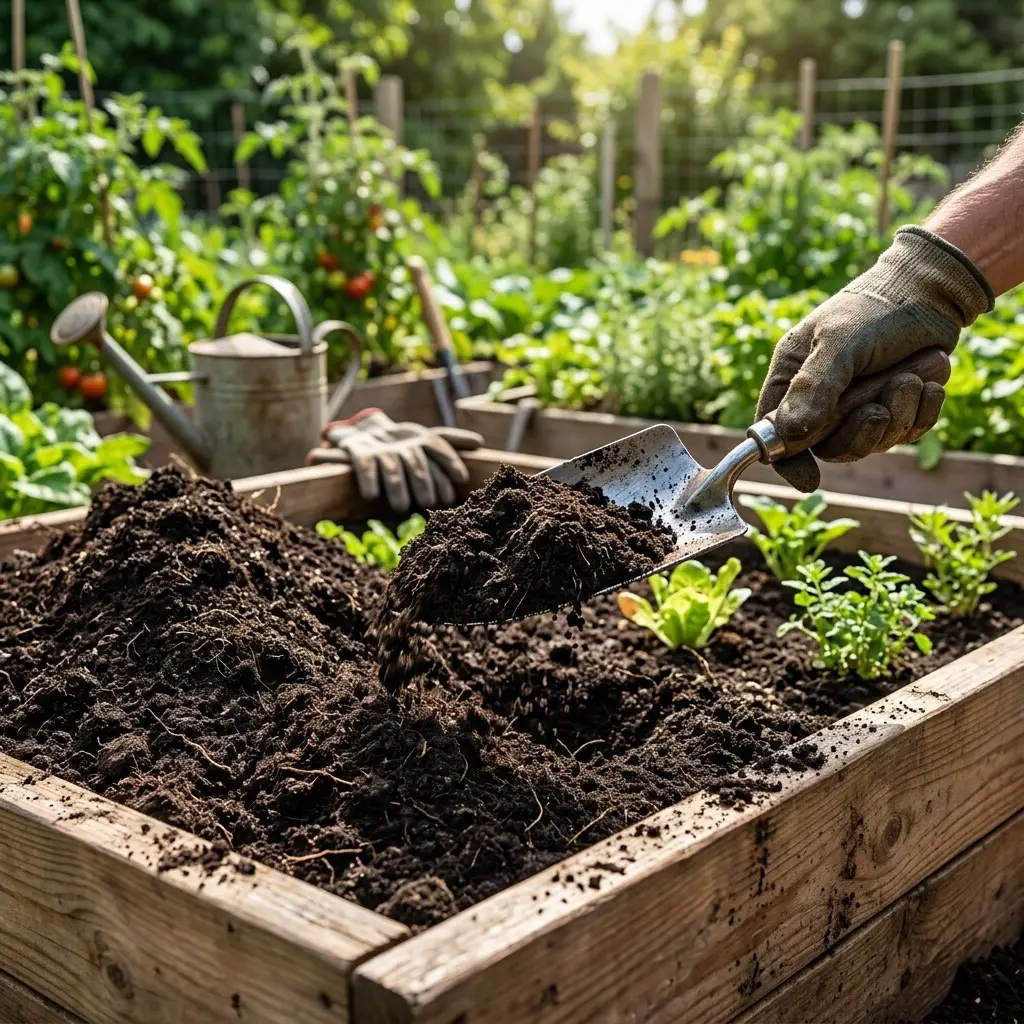
For most new open-bottom raised beds, start by pricing a reputable soil-heavy bulk mix—not bags of pure compost or a universal “one-third of everything” recipe. Penn State Extension’s current starting point is 70% quality soil and 30% compost. Oregon State advises that compost should be a component, not the entire fill. Buy bagged mix for a small contained planter; request bulk supplier data for a full-size bed. Evidence and US purchase options were checked July 29, 2026. This is a research-based guide; Raised Garden Hub has not lab-tested the listed mixes.
| Purchase case | Best starting route | Verify before paying | Usually avoid |
|---|---|---|---|
| One small elevated planter | Manufacturer-approved bagged mix | Container compatibility, volume, ingredients, drainage | Heavy field soil not approved for the planter |
| One 4×4 or larger open-bottom bed | Screened bulk soil/compost mix | Ratio by volume, texture, compost source, recent test, delivered price | Pure compost or mystery “garden blend” |
| Several beds | Bulk delivery quoted by cubic yard | Inside dimensions, delivery minimum, dump location, settling | Dozens of small bags without cost comparison |
| Existing productive bed | Soil test, then targeted top-up | pH, phosphorus, potassium, salts, organic matter | Automatic yearly fertilizer and thick compost |
| Suspected contamination | Tested imported fill in a contained design | Local public-health guidance and source documentation | A thin liner presented as complete remediation |
The evidence-backed starting mix
Penn State Extension’s March 2026 raised-bed guidance recommends 70% soil and 30% compost. Oregon State University Extension says to use up to 25% compost by volume when blending excavated soil, and lists commercial three-way and four-way bulk mixes as common options.
Those recommendations are not a reason to ignore the ingredients. “Topsoil” can be sandy, loamy, or clay-heavy; compost can vary in feedstock, maturity, nutrients, pH, and soluble salts. The useful buying question is:
What are the exact components by volume, and what recent test supports this batch?
Use 70/30 as a quote request when local material is suitable, then adjust only from measured texture, drainage, soil-test results, and crop needs. Do not add perlite, vermiculite, peat, coir, sand, lime, sulfur, or fertilizer automatically.
Calculate volume before choosing bags or bulk
Use the bed’s inside length, width, and actual fill depth:
cubic feet = inside length × inside width × fill depth
cubic yards = cubic feet ÷ 27
A 4×8 bed filled to 12 inches holds 32 cubic feet, or about 1.19 cubic yards, before deducting headspace, rounded corners, braces, or existing soil. That is not 2.7 cubic feet. Measure first because an error of even three inches across a 4×8 footprint changes the order by eight cubic feet.
Raised Bed Soil Calculator
Enter inside dimensions to estimate base fill volume and bag count.
Supplier-quote scenarios — not prescriptions
- Penn State 70/30 starting point: — cu ft quality soil + — cu ft finished compost
- OSU up-to-25% compost scenario: — cu ft soil/planting mix + — cu ft finished compost
Use these only to request comparable quotes. Actual material depends on soil texture, compost analysis, drainage, crop, bed design, and a soil test. Do not fill the bed with compost alone.
Enter the bed's inside dimensions to compare bagged and bulk supply.
Compare bagged mix for a small project →Add frame, delivery, and accessories →Add a small contingency only after checking the supplier’s settling guidance and whether you can buy a partial yard. Oregon State notes that newly filled beds sink as compost decomposes.
Bagged mix versus bulk delivery
Choose bagged raised-bed mix when
- the planter is small enough that bag handling and unit price remain reasonable;
- the manufacturer specifies a container-style or raised-bed medium;
- there is no safe bulk-delivery location;
- the ingredient panel and volume are clear.
Do not select from bag weight alone. Compare price per cubic foot, published ingredients, product use, and the number of bags required. A heavy bag is not evidence of higher compost quality.
Choose bulk soil mix when
- the calculated requirement approaches a cubic yard;
- several beds are being filled;
- a local supplier can provide mix and test information;
- delivered cost is lower than the full bag count.
Request the quote in cubic yards and include delivery, minimum order, access, and placement fees. Raised Garden Hub does not receive a commission from local landscape suppliers; that route is still often the rational purchase for a high-volume project.
Supplier checklist
Ask every bag brand or bulk supplier for:
- Components and ratios by volume, not only a product name.
- Mineral-soil texture or a description backed by testing.
- Compost feedstock, maturity, and screening size.
- pH and soluble salts/electrical conductivity for the current product or batch.
- Contaminant and weed-control practices appropriate to your location.
- Delivered unit price per cubic foot or cubic yard.
- Expected settling and whether a top-up is included or available.
Oregon State’s compost guidance says good finished compost should be crumbly and earthy-smelling, without trash or large debris. It also notes that mushroom- and manure-based products may have high soluble salts. These are screening criteria, not a substitute for a test report.
Avoid these expensive mistakes
- Pure compost as the entire fill. It lacks the mineral component Extension guidance calls for and may create nutrient or salt problems.
- A fixed universal recipe. Climate, soil texture, compost, bed type, and crop change the result.
- Unspecified “premium garden soil.” A marketing name does not reveal the ratio or batch.
- Fertilizer before testing. University of Minnesota Extension documents widespread excess phosphorus in garden soils and advises choosing nutrients from soil-test recommendations.
- Ignoring wet weight and delivery access. Especially important for elevated planters, decks, and yards without a safe dump location.
- Filling to the rim without measuring. Leave the planned headspace and account for mulch.
Refresh an existing bed from evidence, not a schedule
University of Minnesota Extension recommends sampling soil from the beds themselves and says a lab test can guide compost, manure, fertilizer, pH, and contaminant decisions. Its current guide suggests testing every three to five years and when making a major change; test sooner when performance, salinity, contamination, or repeated heavy amendments are concerns.
When the result calls for a nutrient input, compare the guaranteed analysis and label—not the “raised-bed” marketing—with the research-based fertilizer buyer guide.
Oregon State suggests a quarter-inch to one-inch compost layer for existing vegetable beds. That is a range, not an annual requirement for every bed. Skip phosphorus-containing amendments when the soil test says phosphorus is already sufficient.
Final buying decision
- Small contained planter: buy the mix specified for that design.
- Full-size open-bottom bed: price a tested soil-heavy bulk mix first.
- Several beds: compare delivered cubic-yard cost, not bag price.
- Existing bed: test before adding compost or fertilizer.
Next, calculate frame, soil, delivery, irrigation, and accessory spend with the raised-bed total-cost calculator. Then compare raised-bed kits using the actual soil bill rather than the frame price alone.
Frequently asked questions
What is the best soil mix ratio for raised garden beds?
Penn State Extension currently recommends a 70% soil and 30% compost starting mix. Oregon State University Extension says raised beds should not be filled with compost alone and gives up to 25% compost by volume when mixing excavated soil. Treat these as evidence-based starting points, then adjust from a soil test, the actual soil texture, compost analysis, drainage, and crop.
Can you use potting mix in a raised garden bed?
A contained elevated planter may require a container-style mix specified by its manufacturer. For a large open-bottom framed bed, potting mix is often an expensive way to buy the required volume and lacks the mineral-soil component in the Penn State and Oregon State raised-bed guidance. Match the product to the bed design.
Should a raised bed be filled with compost alone?
No. Oregon State University Extension specifically advises against filling framed raised beds with compost alone. Excess compost can raise soluble salts or nutrients, and manure-based compost may add more phosphorus than the crop needs.
How much soil does a 4x8x12-inch raised bed hold?
The geometric volume is 32 cubic feet, or about 1.19 cubic yards, before deducting headspace, rounded corners, internal braces, or existing soil. Use the bed's inside dimensions and planned fill line, then allow for settling rather than relying on bag-count rules.
What should I ask a bulk soil supplier?
Ask for the exact mix by volume, soil texture, compost feedstock and maturity, screened particle size, pH, soluble salts or electrical conductivity, weed-control process, recent test report, delivery minimum, and delivered price. A marketing name such as premium garden mix is not a specification.
How do I refresh raised-bed soil?
Test the bed rather than adding the same amendments every year. Oregon State University Extension suggests a quarter-inch to one-inch compost layer for existing garden beds, while University of Minnesota Extension warns that repeated compost and manure can build excess phosphorus. Use the soil-test recommendation and account for settling.