Raised Bed Soil Calculator
Enter the inside dimensions to calculate base volume, cubic yards, bag count, and optional blend scenarios. Allow separately for headspace, settling, and the actual fill plan.
Also called a garden soil calculator or planter soil calculator — the same length × width × depth formula works for raised beds, planters, and Mel's Mix batches.
Raised Bed Soil Calculator
Enter inside dimensions to estimate base fill volume and bag count.
Supplier-quote scenarios — not prescriptions
- Penn State 70/30 starting point: — cu ft quality soil + — cu ft finished compost
- OSU up-to-25% compost scenario: — cu ft soil/planting mix + — cu ft finished compost
Use these only to request comparable quotes. Actual material depends on soil texture, compost analysis, drainage, crop, bed design, and a soil test. Do not fill the bed with compost alone.
Enter the bed's inside dimensions to compare bagged and bulk supply.
Compare bagged mix for a small project →Add frame, delivery, and accessories →How to use this raised bed soil calculator
Type in your bed's length (feet), width (feet), anddepth (inches). If you have more than one bed of the same size, change theBeds field. The results update instantly — no button to press.
Tick the lower organic layer option only if that is your documented plan. The calculator subtracts one third as a transparent scenario estimate—not as a universal horticultural recommendation. Organic material decomposes and settles, so expect future top-ups and keep an adequate crop-specific root zone of quality mineral soil and compost.
The soil-volume formula (and a worked example)
The calculation is straightforward:
Cubic feet = Length (ft) × Width (ft) × Depth (ft)
Because depth is usually measured in inches, divide it by 12 first.
Worked example — a standard 4×8 ft bed at 12-inch depth:
- Convert depth: 12 in ÷ 12 = 1 ft
- Volume: 4 × 8 × 1 = 32 cubic feet
- In cubic yards: 32 ÷ 27 = 1.19 cu yd
- Bags (1.5 cu ft each): 32 ÷ 1.5 = 21–22 bags, rounded up before any separate settling allowance
To convert cubic feet to cubic yards — which bulk suppliers use — divide by 27. One cubic yard = 27 cubic feet. Compare local delivered bulk pricing with bagged pricing; delivery, access, minimum order, and actual product volume can change which option is cheaper.
How much soil for common raised bed sizes
Use this quick-reference table for the most popular raised bed dimensions. All figures assume premium mix from top to bottom with no filler layer.
| Bed size (L×W) | 12" deep | 18" deep | 24" deep |
|---|---|---|---|
| 2×4 ft | 8 cu ft / 6 bags | 12 cu ft / 8 bags | 16 cu ft / 11 bags |
| 4×4 ft | 16 cu ft / 11 bags | 24 cu ft / 16 bags | 32 cu ft / 22 bags |
| 4×8 ft | 32 cu ft / 22 bags | 48 cu ft / 32 bags | 64 cu ft / 43 bags |
| 4×12 ft | 48 cu ft / 32 bags | 72 cu ft / 48 bags | 96 cu ft / 64 bags |
| 4×16 ft | 64 cu ft / 43 bags | 96 cu ft / 64 bags | 128 cu ft / 86 bags |
Bags = 1.5 cu ft each, rounded up. Add any headspace or settling allowance separately for the chosen material and fill plan.
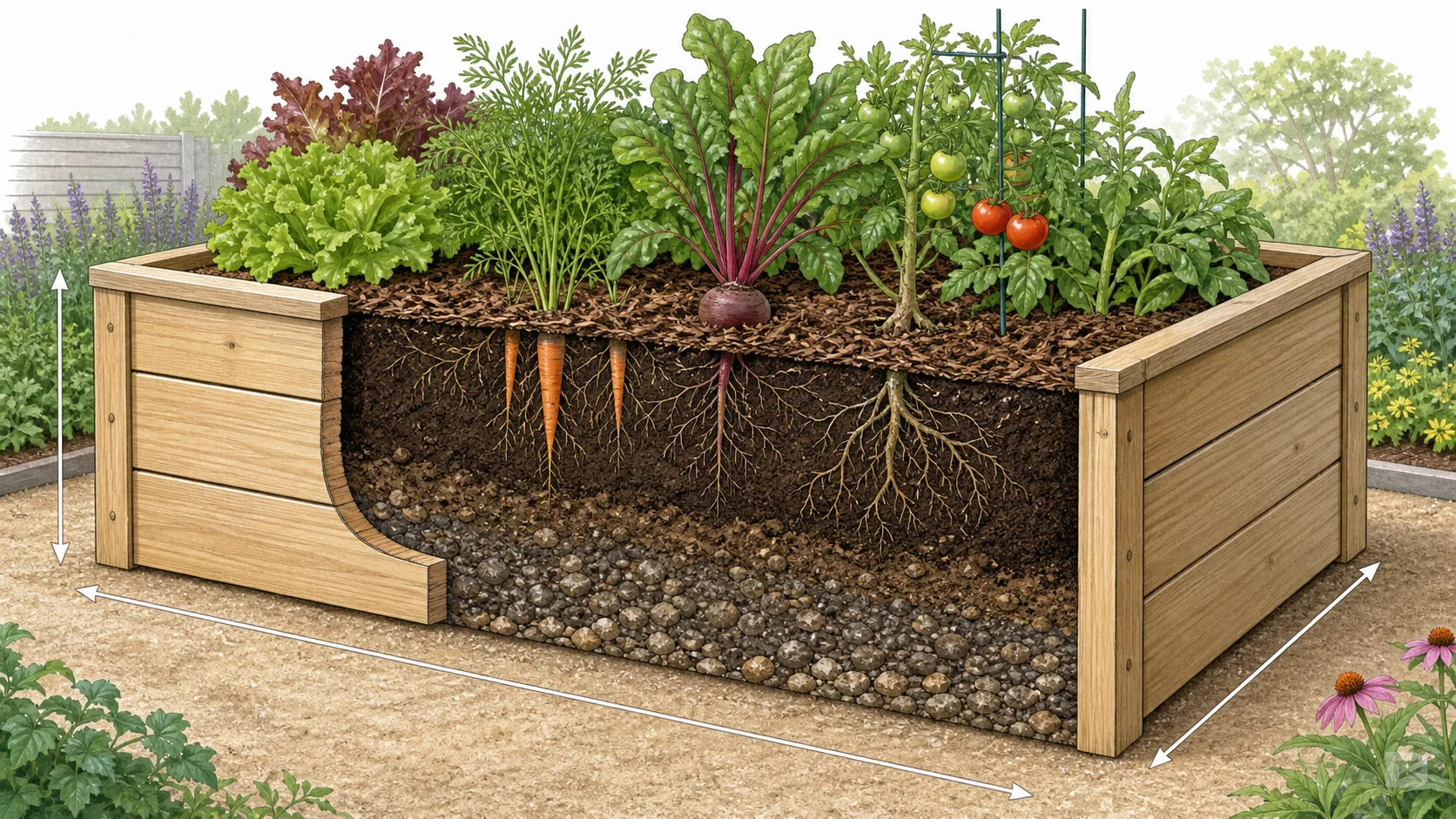
Optional lower layers in very tall beds
University of Minnesota Extension describes filling large, deep beds with materials such as logs, branches, or wood chips below a quality soil-and-compost root zone. This can reduce the initial purchased volume, but the organic material decomposes and settles. It is an optional site-specific method, not evidence that every bed should reserve exactly one third.
- Woody lower layer: use only suitable untreated material, keep enough quality root-zone mix above it for the intended crop, and plan for settling. See our guide onwhat to put at the bottom of a raised garden bedfor the trade-offs.
- Full mineral-soil/compost fill: use suitable mineral soil plus finished compost when consistent structure and lower first-season settling matter. Read theguide to filling a raised garden bedbefore choosing a method.
Enable the lower-layer toggle only to compare a one-third scenario with full-depth fill. The result is initial purchased volume, not a promise that no future top-up will be needed.
What soil mix should you use in a raised garden bed?
Use locally appropriate mineral soil, finished compost, drainage, and a soil test. The correct blend depends on the source material and crop; three planning options are:
- Mel's Mix (equal-third soilless-style blend): 1/3 blended finished compost, 1/3 peat moss or coco coir, 1/3 coarse vermiculite — the ratio popularized by Mel Bartholomew'sSquare Foot Gardening and often searched as a "Mel's Mix calculator." This is one optional recipe, not a universal Extension standard; test and adjust fertility and pH. The calculator above shows its volume split when you enable the toggle. For a deep dive, see ourbest soil mix for raised garden beds.
- Mineral soil plus compost: Penn State Extension recommends about 70% quality soil and 30% compost as a starting point; Oregon State advises up to 25% compost by volume. Local soils differ, so ask for a supplier analysis and use a soil test.
- Bagged potting, planter, or raised-bed mix: Brands like Miracle-Gro, FoxFarm, and Espoma sell blends specifically labeled for raised beds and planters. Convenient for small beds or top-dressing. Multiply the cubic feet from the calculator above by the bag size to find how many to buy.
Check out our deep dive on soil for a 4×8 raised bedif that's the standard size you're planning — it covers costs, brand picks, and ordering tips.
Ready to order? Browse top-rated raised bed soil mixes on Amazon — delivered right to your door.
Shop raised bed garden soil on Amazon →Raised Garden Hub may earn a small commission on purchases made through our links at no extra cost to you.
Frequently asked questions
How much soil do I need for a raised bed?
Multiply inside length × inside width × planned fill depth, with depth converted to feet. A nominal 4×8 ft bed filled to 12 inches is 32 cubic feet before headspace or settling. Bag count is a base estimate; check the actual bag volume and add a material-specific allowance separately.
How do I calculate cubic feet of soil?
Use the formula: cubic feet = length (ft) × width (ft) × depth (ft). Since raised bed depth is usually measured in inches, divide it by 12 first. Example: 4 ft × 8 ft × (12 in ÷ 12) = 32 cubic feet. Divide by 27 to convert to cubic yards.
How much soil for a 4x8 raised bed?
A 4×8 ft raised bed needs 32 cubic feet at 12 inches deep, or 48 cubic feet at 18 inches deep. At 12 inches you will need about 21–22 bags of 1.5 cu ft bagged mix, or roughly 1.2 cubic yards of bulk soil.
How many bags of soil for a raised bed?
Divide the base cubic feet by the actual bag volume and round up. If bags are 1.5 cubic feet, a 32 cu ft bed needs 22 bags before any separate headspace or settling allowance. Settling varies by material, so a fixed extra percentage is not guaranteed.
Can I save money filling a deep raised bed?
Very tall beds may use a lower layer of woody or other organic material, but it will decompose and settle. Keep enough quality mineral soil and compost above it for your crops. The optional calculator toggle subtracts one-third only as a planning scenario, not as a universal horticultural rule.
What is the best soil mix for a raised garden bed?
There is no single best mix for every site. Penn State Extension recommends a starting point of about 70% quality soil and 30% compost, while Oregon State advises up to 25% compost by volume. Use a soil test and locally appropriate mineral soil; do not fill the bed with compost alone.
Is this the same as a garden soil calculator or planter soil calculator?
Yes. Whether you call it a raised bed soil calculator, a garden soil calculator, or a planter soil calculator, the underlying math is the same length × width × depth formula. Enter your container's inside dimensions above to get cubic feet, cubic yards, and bag counts for a raised bed, planter box, or any other fixed-volume container.
How do I convert cubic feet of soil to cubic metres?
Multiply cubic feet by 0.0283 (or divide by 35.3) to get cubic metres. A 4×8 ft bed at 12 inches deep is 32 cubic feet, which is about 0.91 cubic metres. If you prefer working entirely in metric, use the same formula with metres: length (m) × width (m) × depth (m).
What is Mel's Mix and does the calculator support it?
Mel's Mix is the equal-thirds compost, peat moss (or coco coir), and vermiculite blend from Mel Bartholomew's Square Foot Gardening method. The optional lower-layer toggle above is a different, bottom-fill scenario — for a true Mel's Mix split, use the base cubic-feet result and divide it evenly into thirds by volume.