By Azura · Updated July 2026 · Raised Garden Hub is reader-supported. When you buy through links on our site, we may earn an affiliate commission at no extra cost to you.
For an open-bottom bed on healthy native soil, buy no full bottom liner. Use plain cardboard only for temporary grass or weed suppression. Buy welded hardware cloth only when burrowing animals are a real site problem. For a patio or deck, choose a contained planter or manufacturer-approved permeable base after verifying drainage and structural load. Sources and US product availability were checked July 29, 2026. This is research-based guidance; Raised Garden Hub has not run a comparative liner or pest-exclusion test.
| Site or problem | What to use | What to avoid or verify | Purchase decision |
|---|---|---|---|
| Healthy native soil, no serious weeds or burrowers | Open bottom | Verify soil quality and drainage | Buy no liner |
| Existing lawn or weeds | Plain, tape-free cardboard as a temporary smothering layer | It can slow infiltration until it softens; it is not a permanent barrier | Use material already on hand |
| Gophers, moles, or other burrowers | Welded-wire or hardware-cloth barrier, securely attached | Match mesh to the animal; inspect sharp edges and connections | Buy only for documented pressure |
| Concrete or patio | Purpose-designed contained base or permeable liner with a real drainage route | Runoff destination, staining, property rules, and total wet weight | Prefer a complete planter system |
| Deck or balcony | A container specifically approved for that placement | Structural load, waterproofing, drainage, wind, and landlord/HOA rules | Do not improvise an open-bottom bed |
Galvanized Welded Hardware Cloth
- Wire barrier format supported by Extension guidance
- Water can pass through the mesh
- Can be attached to the bed frame before filling
- Not a weed or drainage fix
- Mesh must match the target animal
- Cut edges require gloves and safe fastening
- No Raised Garden Hub exclusion test
Product facts are manufacturer- or retailer-published unless this page documents a Raised Garden Hub measurement. Confirm the exact model, live price, and terms before buying.
Choose no liner on healthy soil
An open-bottom bed preserves contact with the soil below and gives roots an additional path downward. Remove aggressive perennial weeds, loosen compaction when appropriate, and correct the site’s drainage before placing the frame. A liner does not repair a low spot, contaminated soil, or water that has nowhere to go.
Choose the no-liner option when:
- the underlying soil is suitable for gardening;
- turf and invasive weeds have been removed or controlled;
- burrowing animals are not an established problem;
- the bed maker does not require a separate base.
If contamination is suspected, do not treat a thin liner as a complete remediation plan. Use local soil-testing and public-health guidance to select an appropriate contained growing system.
Use cardboard only for temporary weed suppression
Penn State Extension’s 2025 construction guidance says cardboard may be laid over grass or existing weeds before filling. That makes cardboard an optional site-preparation material, not a required component in every bed.
Use plain corrugated cardboard with tape, staples, labels, and glossy coatings removed. Avoid promising an exact decomposition time: moisture, temperature, thickness, soil contact, and microbial activity all change how quickly it softens. If immediate infiltration is critical, remove the turf or vegetation instead of assuming cardboard has no hydraulic effect.
Choose cardboard if: the bed is going over lawn or annual weeds and a temporary smothering layer is useful.
Skip cardboard if: the site is already bare and suitable, root access is the priority, or the installation instructions specify a different base.
Use wire only for a defined burrower problem
Oregon State University Extension recommends chicken wire or hardware cloth beneath raised beds to exclude or deter moles and gophers. Its separate pest-management guidance specifically calls for a welded-wire bottom barrier in raised beds.
Before ordering, identify the animal rather than treating every tunnel as the same problem. Confirm:
- mesh opening recommended for the target animal in your region;
- enough material to cover the full footprint without an open edge;
- a safe fastening method compatible with the frame;
- corrosion exposure and expected inspection access;
- gloves, eye protection, and covered cut edges.
Wire mesh reduces an entry route; it is not proof against every animal and should not be marketed as permanent exclusion.
Hardscape requires a complete drainage plan
A bed on concrete, a patio, a roof terrace, or a deck behaves more like a large container. The purchase decision is not simply “fabric or plastic.” It includes the base, outlet, soil retention, runoff route, wet weight, surface protection, and property rules.
Prefer a frame with a documented base or a purpose-built elevated planter. Use a permeable liner only as part of that design. Do not place an open-bottom frame on a deck and invent a sealed plastic floor: an impermeable sheet can retain water, and uncontrolled drainage can damage the surface below.
Compare contained patio planters →Do not buy a “universal” bottom layer
- Impermeable plastic: not a default underlayment for an open-bottom bed; it needs an engineered outlet and manufacturer-supported use.
- Gravel or rocks: they do not create an outlet. Fix the actual drainage path and soil compaction.
- Landscape fabric on soil: not automatically needed and can complicate future root access and maintenance.
- Unknown treated scraps or printed packaging: do not place materials of unknown composition in a food-growing bed.
- Hardware cloth without pest evidence: adds cost, sharp edges, and installation work without solving weeds or poor drainage.
Bulk fill is a separate decision
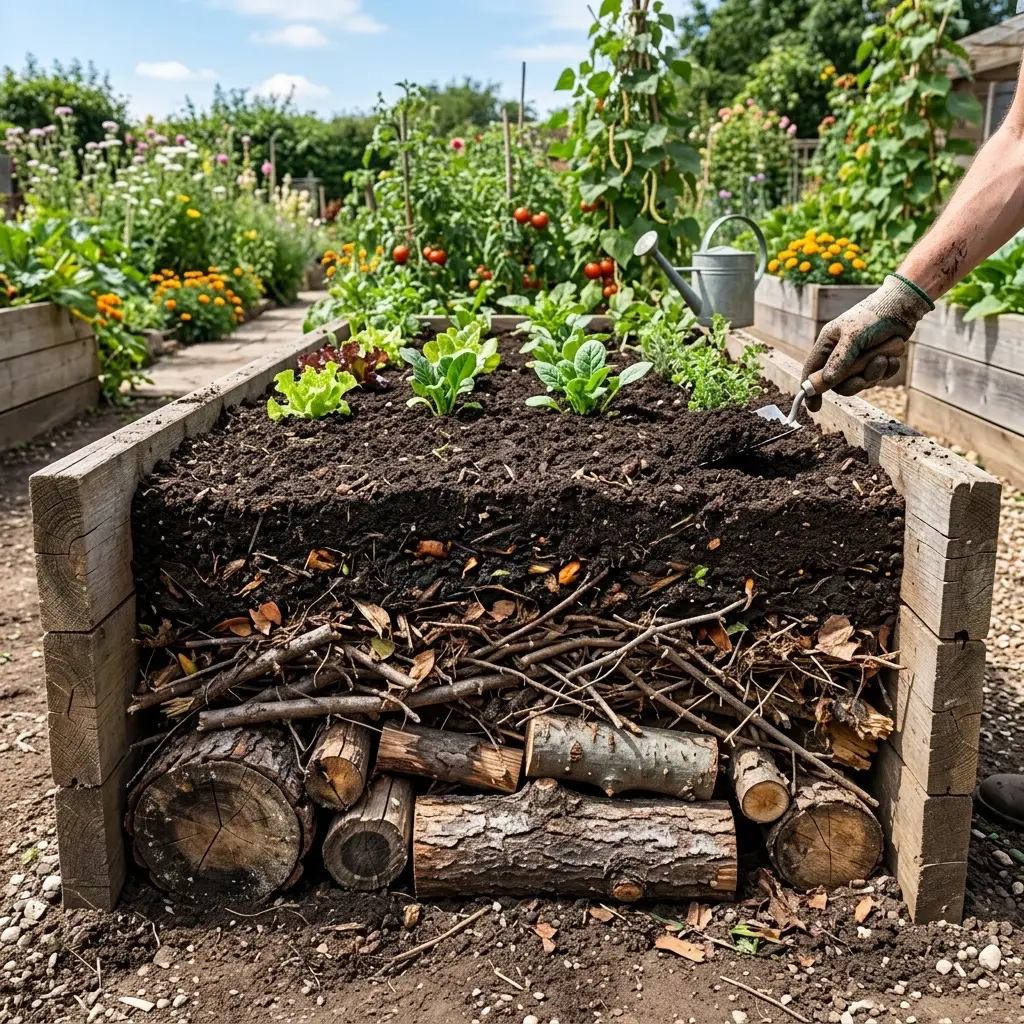
Logs, branches, leaves, and other bulk materials are not liners. In a tall bed they reduce the initial volume of purchased soil, but they also decompose and settle. Follow the exact bed manufacturer’s fill instructions and preserve a suitable growing zone for the intended crops. See the hugelkultur evidence and tradeoffs before using woody fill.
Use the calculator for the full bed first. Then compare the growing-mix volume and refill risk instead of treating free bulk material as a zero-cost substitute.
Raised Bed Soil Calculator
Enter inside dimensions to estimate base fill volume and bag count.
Supplier-quote scenarios — not prescriptions
- Penn State 70/30 starting point: — cu ft quality soil + — cu ft finished compost
- OSU up-to-25% compost scenario: — cu ft soil/planting mix + — cu ft finished compost
Use these only to request comparable quotes. Actual material depends on soil texture, compost analysis, drainage, crop, bed design, and a soil test. Do not fill the bed with compost alone.
Enter the bed's inside dimensions to compare bagged and bulk supply.
Compare bagged mix for a small project →Add frame, delivery, and accessories →Final checkout rule
- Bed on healthy soil: buy no liner.
- Bed over grass or weeds: optional plain cardboard, usually already available.
- Documented burrower pressure: buy correctly selected welded hardware cloth.
- Patio or deck: buy a complete contained planter or approved base with verified drainage and load.
After choosing the base, calculate the whole project—frame, soil, delivery, barrier, irrigation, and accessories—with the raised-bed total-cost calculator. Then compare the best raised-bed kits without hiding the soil and installation cost.
Frequently asked questions
What should I put at the bottom of a raised garden bed?
On healthy native soil, a full bottom liner is usually unnecessary. Use plain cardboard only when temporary grass or weed suppression is needed. Add a securely attached welded-wire barrier when local burrowing animals are a documented problem. On concrete, a patio, or a deck, use a contained planter system with a permeable base and verified drainage and structural load.
Should I line the bottom of a raised bed with plastic?
Do not place an impermeable plastic sheet across an open-bottom bed unless the exact manufacturer design requires it and provides a drainage path. Penn State Extension warns that black plastic underlayment is not water permeable. A hardscape installation should use a purpose-designed contained base rather than an improvised sealed floor.
Do I need landscape fabric under a raised bed?
Not automatically. On soil, a fabric layer can interfere with root access and later maintenance. On hardscape, a permeable liner may retain soil while allowing water through, but the complete planter still needs controlled drainage. Follow the exact frame or base instructions.
Can I put rocks or gravel at the bottom of a raised bed?
A gravel layer is not a substitute for an outlet, a permeable base, or a suitable soil mix. Diagnose where water can leave the bed and correct compaction or blocked drainage rather than buying gravel as a universal fix.
What can I use to deter gophers under a raised bed?
Oregon State University Extension recommends welded-wire barriers under raised beds to deter moles and gophers. Match the mesh and attachment method to the target animal and local conditions, protect hands from cut wire, and inspect the frame connection. No barrier guarantees permanent exclusion.
Can I fill the bottom of a tall raised bed with logs?
Woody bulk fill is a site-specific design, not a universal liner. It decomposes and settles, changes the amount of growing mix required, and can complicate later refilling. Verify the bed maker's fill instructions and keep the crop's intended root zone in a suitable, tested soil mix.