By Azura · Updated June 2026 · Raised Garden Hub is reader-supported. When you buy through links on our site, we may earn an affiliate commission at no extra cost to you.
Cucumber leaves turn yellow most often because of overwatering or poor drainage — but nutrient deficiency, pests, and disease are close behind. Work through these causes from most to least common and you will usually spot the problem fast. In a raised bed you have more control over drainage and soil than in-ground gardeners do, which makes most of these issues easier to fix.
1. Overwatering and Poor Drainage
Soggy soil cuts off oxygen to cucumber roots. Within a few days, stressed roots can no longer pull up nutrients even when they are present, and the lower leaves turn uniformly yellow. The soil surface may look fine on top while the deeper layers stay waterlogged.
How to identify it: Push your finger two inches into the soil. If it feels wet rather than moist, you are overwatering. Roots pulled from the bed may look brown and mushy rather than white and firm.
How to fix it: Let the top inch of soil dry out between waterings. Cucumbers need consistent moisture but not constant moisture — aim for deep, infrequent watering rather than daily light sprinkles. If your bed holds water, your soil mix may be too dense. A good raised-bed mix drains freely within seconds of watering. You can also use the soil calculator to check that you have enough volume for proper drainage.
A simple rule: water deeply twice a week rather than lightly every day. Cucumbers prefer dry feet between waterings.
2. Nitrogen Deficiency (and Magnesium or Iron)
Cucumbers are heavy feeders. In a new raised bed with low organic matter, or in an established bed that has not been amended in a season or two, nutrients run short fast.
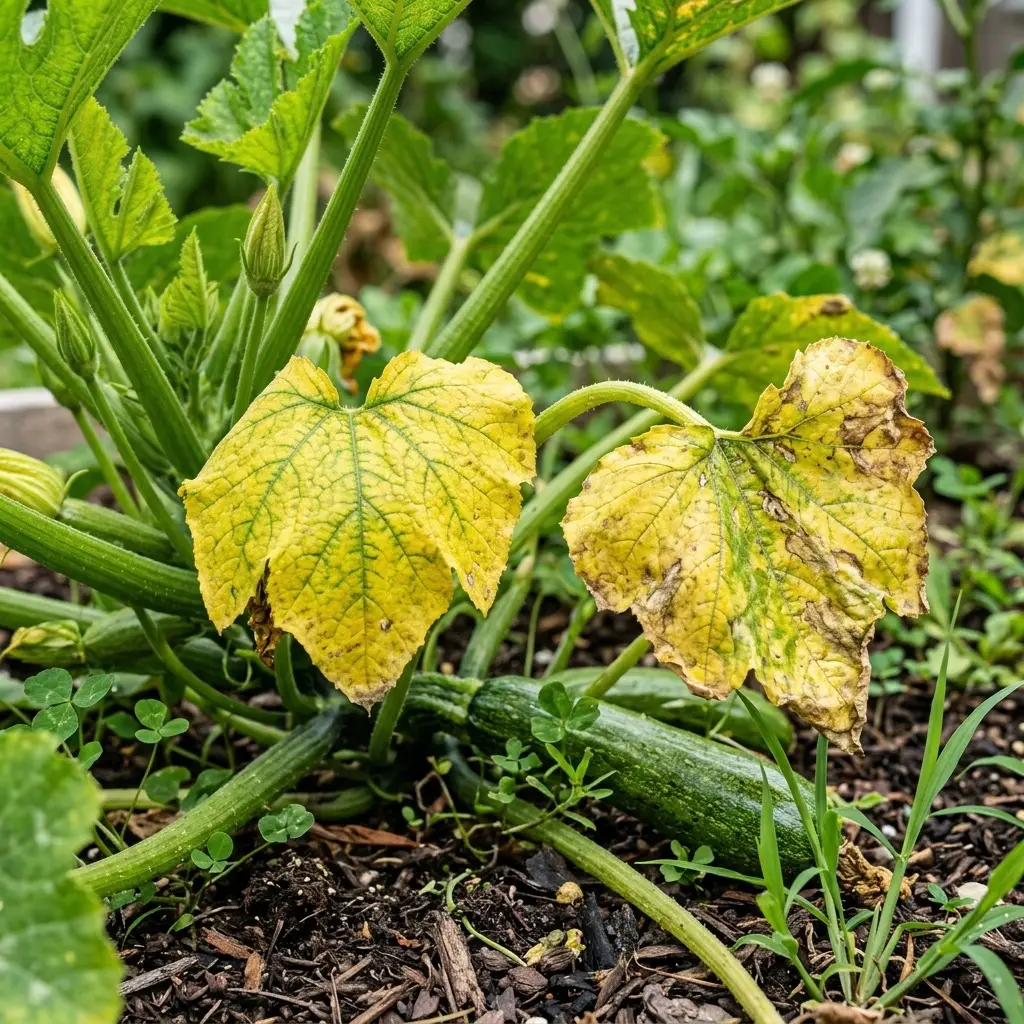
Nitrogen deficiency shows up as uniform yellowing of the oldest leaves first, working up the plant. The tips yellow first, then the whole leaf. New growth at the vine tips stays green because the plant pulls nitrogen from old tissue to feed new growth.
Magnesium deficiency looks different: the leaf veins stay green while the tissue between them yellows (interveinal chlorosis). It often appears mid-season when plants are setting heavy fruit and drawing down mineral reserves.
Iron deficiency causes interveinal chlorosis too, but starts on the newest leaves rather than the oldest. It is usually a soil pH problem — when pH creeps above 7.0, iron becomes chemically unavailable even if it is physically present.
How to fix it: For nitrogen, apply a balanced vegetable fertilizer or a nitrogen-forward product at the label rate. Top-dress with an inch of finished compost. For magnesium, a soil test first is worth the few dollars — if confirmed low, dissolve one tablespoon of Epsom salts per gallon of water and apply once. Do not apply Epsom salts without confirmation; excess magnesium blocks calcium uptake. For iron issues, test your pH and bring it back to 6.0–6.8 where most nutrients are accessible.
3. Natural Lower-Leaf Aging
This is the cause gardeners most often panic about unnecessarily. As cucumbers grow and set fruit, the plant redirects energy upward. The lowest leaves, now shaded by the canopy and receiving less light, yellow and drop. This is completely normal.
How to identify it: The plant is growing vigorously, producing new leaves and flowers, and the yellowing is limited to the bottom two or three leaves. There are no spots, lesions, or pest signs.
How to fix it: Nothing is needed. You can remove the yellowed leaves with clean scissors to improve airflow and aesthetics, but the plant does not require intervention. If you are new to raised-bed gardening, this is one of the first surprises — healthy plants shed old leaves.
4. Too Little Sun
Cucumbers need at least six hours of direct sun daily, and eight hours produces the best yields. In partial shade the leaves cannot photosynthesize efficiently, turn pale, then yellow, and the plant sets little fruit.
How to identify it: Yellowing is diffuse across the plant rather than localized to lower leaves. Growth is slow and vines look leggy. The bed may be shadowed by a fence, tree, or taller plants.
How to fix it: Relocate container beds if possible. In fixed beds, prune nearby shrubs or remove shade structures. Vertical trellising helps keep the canopy in the sun zone and off the soil.
5. Pests — Cucumber Beetles, Spider Mites, and Aphids
Sap-sucking pests damage leaf cells and cause stippled, pale, or yellow patches. Heavy infestations can yellow entire leaves quickly.
Cucumber beetles (striped and spotted) chew leaves and transmit bacterial wilt. Damage looks like ragged holes plus yellowing. The beetles are yellow with black stripes or spots and roughly a quarter inch long.
Spider mites thrive in hot, dry weather. They cause fine yellow stippling across the leaf surface. Turn a leaf over and look for tiny moving dots and fine webbing along the veins.
Aphids cluster on the undersides of young leaves and at growing tips. They excrete sticky honeydew that can grow black sooty mold, and they spread cucumber mosaic virus. Leaves curl and yellow where colonies are dense.
How to fix it: For beetles, use floating row covers early in the season before vines flower, then remove for pollination. Hand-pick adults and destroy egg clusters (orange ovals under leaves). For mites and aphids, spray the undersides of leaves with insecticidal soap or neem oil in the early morning or evening. Repeat every five to seven days for three cycles. Strong water sprays dislodge aphid colonies too. You will face some of the same pest pressure on related plants — the same approach works for squash bugs.
6. Disease — Downy Mildew, Powdery Mildew, Cucumber Mosaic Virus, and Bacterial Wilt
Downy Mildew
Yellow angular blotches appear on the top of the leaf, bounded by the leaf veins. Flip the leaf over and you will see gray-purple fuzzy growth underneath. It spreads rapidly in cool, wet conditions with poor airflow.
Fix: Water at the base, never overhead. Space plants for airflow. Remove and bag affected leaves. Apply a copper-based fungicide or potassium bicarbonate spray preventively if downy mildew is common in your area.
Powdery Mildew
A white or gray powdery coating appears on leaf surfaces, often starting as spots and spreading. Affected leaves yellow and eventually brown. It thrives in warm days and cool nights.
Fix: Improve airflow by pruning interior leaves. Apply a diluted potassium bicarbonate spray or a solution of one teaspoon baking soda per quart of water. Remove heavily affected leaves. Problems with mildew on cucurbit family plants also show up frequently on zucchini and squash.
Cucumber Mosaic Virus
Irregular yellow-green mottling (not solid yellowing) with puckered, distorted leaf texture. New growth may look stunted or shoestring-thin. Spread by aphids.
Fix: There is no cure. Remove and bag infected plants immediately to prevent aphid transmission to healthy plants. Control aphid populations on remaining plants. Plant virus-resistant varieties next season — they are widely available and worth seeking out.
Bacterial Wilt
Leaves wilt and yellow rapidly, starting on one or two branches and spreading. If you cut a wilted stem and touch the two cut ends together, then pull them slowly apart, you may see fine sticky threads — a classic sign. Spread by cucumber beetles.
Fix: There is no cure once the plant is infected. Remove the plant and control cucumber beetles on surviving plants with row covers and targeted treatment.
Diagnosis Flow
Work through this order when you see yellow leaves:
- Check the soil moisture — is the soil soggy? Reduce watering.
- Look at which leaves are affected — bottom leaves only on a healthy plant suggests aging or early nitrogen deficiency. If yellowing is moving up the plant, nitrogen is more likely.
- Check the pattern on the leaf — uniform yellow suggests nitrogen or overwatering; interveinal yellowing suggests magnesium or iron; angular blotches suggest downy mildew; mottled patterns suggest virus.
- Flip the leaves — look for pests (mites, aphids, beetle eggs) on the undersides.
- Check for fungal signs — fuzzy growth underneath (downy mildew) or white powder on top (powdery mildew).
- Check sun exposure — count hours of direct sun reaching the bed.
Prevention in Raised Beds
Most yellowing traces back to soil and water management. A free-draining soil mix and consistent but not constant watering prevent the majority of cases. Before you plant, fill your raised bed with a mix that holds moisture without staying soggy — typically a blend of topsoil, compost, and coarse material like aged wood chips or perlite.
Feed cucumbers every two to three weeks through the growing season with a balanced vegetable fertilizer. Amend with compost each season to replenish organic matter. Mulch the surface to keep soil temperature and moisture even, which reduces the stress cycles that invite disease. Space plants so air moves freely through the canopy — overcrowded vines in humid air are an invitation for mildew. The same planting and soil principles apply to peppers and other heavy-feeding crops in your raised bed.
If you track what went wrong each season and adjust one variable at a time, yellow leaves become easier to diagnose every year. Most problems in a well-built raised bed come down to water, fertility, and airflow — all of which you can control.
Frequently asked questions
Why are my cucumber leaves turning yellow?
The most common cause is overwatering or poor drainage, followed by nitrogen deficiency, pests (cucumber beetles, spider mites, aphids), disease (downy or powdery mildew, cucumber mosaic virus), too little sun, or natural aging of lower leaves.
How can I tell overwatering apart from a nutrient deficiency?
Overwatering yellows the lower leaves evenly and the soil stays soggy; roots often smell sour. Nitrogen deficiency also starts at the oldest leaves but the yellowing moves inward from the tips and the soil is typically dry or low in organic matter. Check your watering frequency and do a finger test before assuming it is a deficiency.
Should I remove yellow cucumber leaves?
Yes — remove badly yellowed or diseased leaves to improve airflow and stop disease spreading. Clip them off cleanly rather than tearing, and dispose of diseased leaves in the trash, not the compost. A few yellow lower leaves on an otherwise thriving plant is just normal aging and removal is optional.
What does nitrogen deficiency look like on cucumbers?
The oldest leaves at the base of the plant turn uniformly pale yellow, then progress up the vine as nitrogen moves from old tissue to new growth. New leaves at the tips stay green. Leaves may feel thin or papery. The fix is a balanced or nitrogen-forward fertilizer applied at the recommended rate, plus a top-dressing of finished compost.
Could it be cucumber mosaic virus?
Cucumber mosaic virus causes irregular yellow-green mottling, not solid yellowing, and is often accompanied by distorted, crinkled leaves and stunted growth. It is spread by aphids. There is no cure once a plant is infected — remove and bag the plant to prevent spread, control aphids on remaining plants, and plant resistant varieties next season.
Why do the bottom leaves yellow first?
Bottom leaves yellow first for two main reasons: natural aging (the plant redirects energy to new growth and fruit) and nitrogen deficiency (the plant pulls nitrogen from older tissue to feed newer growth). Overwatering and root problems also hit the lower canopy first because roots near the bottom of the bed suffer most from oxygen deprivation. If the plant looks otherwise healthy and is fruiting well, yellowing bottom leaves are usually just aging.