By Azura · Updated July 2026 · Raised Garden Hub is reader-supported. When you buy through links on our site, we may earn an affiliate commission at no extra cost to you.
Raised beds can make soil, drainage, access, and weed management easier to control, but results depend on the site and design. A higher bed may reduce low reaching; it does not guarantee no bending or solve every soil and plant problem.
This guide walks you through everything: picking the right spot and bed size, filling it with good soil, choosing crops that are genuinely hard to kill, and avoiding the mistakes that trip up most first-timers.
Why raised beds are so beginner-friendly
In-ground gardens ask you to work with whatever soil your yard happens to have. Raised beds let you start with a perfect mix. That single change eliminates most beginner failures.
Beyond soil control, raised beds offer:
- Fewer weeds — you’re not starting with weed seeds baked into the ground
- Better drainage — roots don’t sit in waterlogged soil
- Earlier planting — raised soil warms up 2–4 weeks ahead of ground soil in spring
- Easier access — no kneeling in the mud; many beds sit at working height
- Defined space — a 4×8 bed is manageable; a big backyard feels overwhelming
You don’t need a lot of land, a tiller, or any prior experience. A single 4×8 bed can feed a family of two in salads all summer.
Step 1: Choose the right spot
Sun is non-negotiable. Most vegetables need 6 or more hours of direct sunlight per day. Walk your yard at noon in spring and clock how many hours a potential spot actually gets — don’t guess.
If your best sunny spot only gets 4–5 hours, lean into leafy greens: lettuce, spinach, kale, and chard will tolerate partial shade. Save your sunniest ground for tomatoes, peppers, and squash.
Water access matters too. Place the bed close enough to a hose or spigot that watering doesn’t feel like a chore. A bed you can’t conveniently water is a bed that dries out and dies.
Level ground is easier, but not required. Raised beds can be shimmed or stepped on a slight slope.
Rule of thumb: Stand at your chosen spot at solar noon. If you can’t see the sun overhead, that spot probably doesn’t get enough light for fruiting vegetables.
Not sure when to set up your bed? Our guide on when to start a raised bed garden breaks down timing by climate zone.
Step 2: Pick the right size and bed
Keep width to 4 feet or less. You should be able to reach the center comfortably from either side without stepping inside. Stepping in compacts the soil — that undoes a lot of what makes raised beds great.
Length is flexible. 4×4 is great for tiny spaces or apartment patios. 4×8 is the standard first bed. 4×12 or longer if you have room and ambition.
Depth matters for roots. Most vegetables do fine in 10–12 inches of depth. Carrots and parsnips prefer 12–18 inches. Shallow-rooted crops like lettuce and herbs can get by with 6 inches. See our full breakdown on how deep a raised garden bed should be.
Material options:
- Cedar or redwood heartwood — naturally decay-resistant; service life varies with species, thickness, moisture, and construction
- Pine — often cheaper and generally less naturally decay-resistant; inspect soil-contact areas regularly
- Metal/galvanized steel — very durable, modern look, heats up faster in spring
- Composite/recycled plastic — maintenance-free but more expensive upfront
For a side-by-side comparison, read metal vs. wood raised garden beds. If space is tight, check out our picks for the best raised garden beds for small spaces.
Our roundup of the best raised garden beds of 2026 covers pre-built options across every budget.
Step 3: Fill it with the right soil
This is where many beginners overspend. Do not fill a framed bed with compost alone or assume one bag recipe works everywhere. Penn State Extension currently gives 70% quality soil and 30% finished compost as a starting point; Oregon State gives an up-to-25% compost example. Ask the supplier for components by volume, soil texture, compost source, and recent test information.
For full details on ratios and amendments, see our guide to the best soil mix for raised garden beds.
Filling a deep bed gets expensive fast. Calculate the full volume first. Woody lower fill is a separate scenario that decomposes and settles; use it only when the crop root zone, exact bed instructions, site, and refill plan support it. See how to fill a raised garden bed.
Use our soil calculator to figure out exactly how many cubic feet of mix you need so you don’t over- or under-buy.
Planning rule: Confirm headspace, supplier minimums, and expected settling before adding a contingency. Measure the fill line later rather than promising a fixed first-season drop.
Step 4: Plant your first season
The 9 easiest crops for beginners
- Lettuce — fast, cut-and-come-again, tolerates partial shade
- Radishes — ready in 3–4 weeks, great for impatient beginners
- Bush beans — no trellis needed, highly productive
- Zucchini — one plant can produce more than you’ll need
- Cherry tomatoes — more forgiving than slicing varieties, long harvest window
- Herbs (basil, cilantro, parsley) — useful daily, grow fast, fill gaps
- Peppers — low-maintenance once established, love hot weather
- Kale — tough, produces for months, handles light frost
- Carrots — give them deep, loose soil and they’ll reward you; stick with varieties under 7 inches long your first season
Spacing matters more than most beginners expect
Overcrowding is the most common first-year mistake. When plants compete for light, water, and nutrients, none of them thrive — and you end up with a crowded, unproductive tangle.
Always follow the spacing on your seed packet or transplant tag. Our raised bed plant spacing chart shows exactly how many plants fit in common bed sizes for each crop.
Step 5: Water and mulch correctly
Raised beds dry out faster than in-ground gardens because they drain more freely and warm up quicker. In summer, plan to water every 2–3 days — more in heat waves.
Water deeply, not frequently. A long, slow soak 2–3 times per week encourages roots to grow down where moisture stays longer. A quick daily sprinkle keeps roots shallow and makes plants drought-sensitive.
Add 1–2 inches of mulch (straw, shredded leaves, or wood chips) on top of your soil after planting. Mulch:
- Cuts watering frequency by 30–50%
- Suppresses weeds
- Regulates soil temperature
- Feeds the soil as it breaks down
Your first-month timeline
Week 1: Assemble bed, fill with soil mix, water thoroughly and let it settle 24 hours before planting.
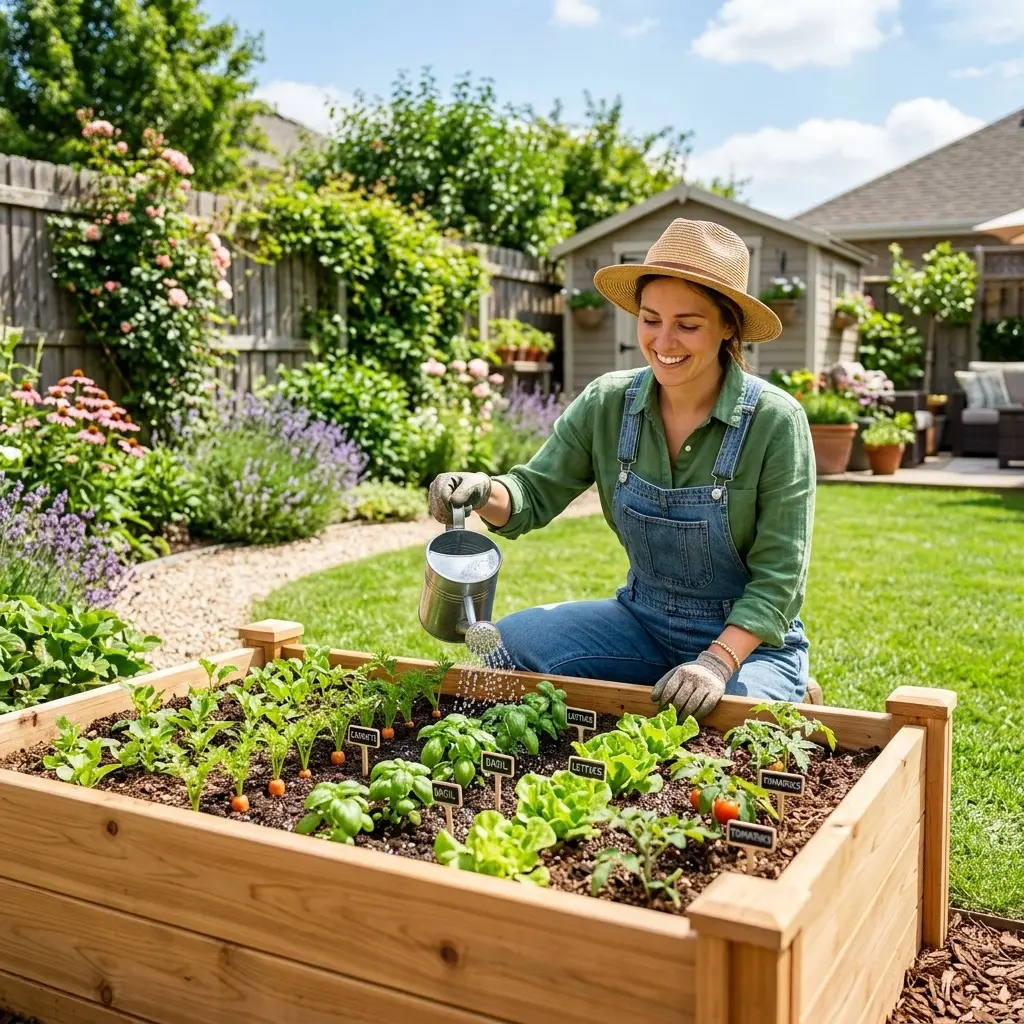
Week 2: Plant seeds or transplants. Water daily for the first week to help transplants establish. Mark rows so you know what’s what.
Week 3: Thin seedlings to proper spacing if direct-seeded. Add mulch around plants. Watch for pests — early detection is easy treatment.
Week 4: Check soil moisture daily by pressing your finger 1 inch into the soil. If it’s dry at that depth, water. Radishes planted week one may be ready to harvest. Lettuce can be harvested outer-leaf style.
Not sure exactly when to get started based on your climate? Our when to start a raised bed garden guide maps out timing by USDA zone.
Common beginner mistakes to avoid
- Planting too much, too close — spacing guidelines exist for a reason; ignore them and nothing thrives
- Using pure garden soil or topsoil — it compacts in raised beds and stunts roots
- Watering a little every day instead of deeply a few times a week — shallow watering creates shallow roots
- Letting the bed dry out in the first two weeks — newly transplanted seedlings have tiny root systems and can’t recover from severe drought stress
- Ignoring the first yellow leaves — yellowing usually signals overwatering, underwatering, or a nutrient deficiency; catch it early
- Skipping mulch — it’s the cheapest, easiest thing you can do and most beginners skip it
How much bed do you actually need?
A single 4×8 bed (32 sq ft) is a genuinely good starting point — enough to grow a meaningful variety without feeling overwhelming. Want to size up or figure out how many beds you need? Use our raised bed size calculator to plan by family size or produce goals.
If you’re working with a balcony, rooftop, or tiny backyard, a 2×4 or 4×4 bed with vertical supports goes a long way. See our best raised garden beds for small spaces for compact options.
Commit one season and you’ll be hooked. Raised bed gardening rewards consistency more than talent — and the soil does most of the hard work once you set it up right.
When you run into the inevitable first-season surprises, these troubleshooting guides will help: aphids on raised bed vegetables, cucumber plants not producing, and raised bed soil drying out too fast.
Before your second season, read 9 raised bed gardening mistakes to avoid — it covers the errors that quietly reduce harvests year after year. And when you are ready to start feeding your plants deliberately, our raised bed fertilizing guide explains exactly when and what to apply.
Frequently asked questions
Is raised bed gardening good for beginners?
Yes — raised beds are one of the most beginner-friendly ways to garden. You control the soil quality from day one, drainage is built-in, weeds are much easier to manage, and the defined space keeps things from getting overwhelming.
How big should my first raised bed be?
A 4×8 foot bed is the classic starting size. It's large enough to grow a real variety of vegetables but small enough that you can reach the center from either side without stepping in. Wider than 4 feet and you'll be straining to weed the middle.
What is the easiest vegetable to start with in a raised bed?
Lettuce, radishes, and bush beans are the easiest. Lettuce germinates fast, tolerates some shade, and you can harvest outer leaves while the plant keeps growing. Radishes are ready in as little as 3–4 weeks, which gives beginners a quick confidence boost.
How much sun do raised beds need?
Most vegetables need at least 6 hours of direct sunlight per day. If you only get 4–5 hours, stick with leafy greens like lettuce, spinach, and kale, which tolerate partial shade better than fruiting crops like tomatoes or peppers.
Do raised beds need more watering than in-ground gardens?
Yes, raised beds dry out faster than in-ground plots because they drain more freely and warm up quicker. In hot weather, check the top inch of soil daily and plan to water every 2–3 days. Mulch cuts watering frequency significantly.
How much does it cost to start a raised bed garden?
A basic 4×8 cedar bed, quality soil mix, and starter plants or seeds typically runs $150–$300 for the first season. Costs drop sharply in year two since you only need to top off the soil and buy seeds.