By Azura · Updated June 2026 · Raised Garden Hub is reader-supported. When you buy through links on our site, we may earn an affiliate commission at no extra cost to you.
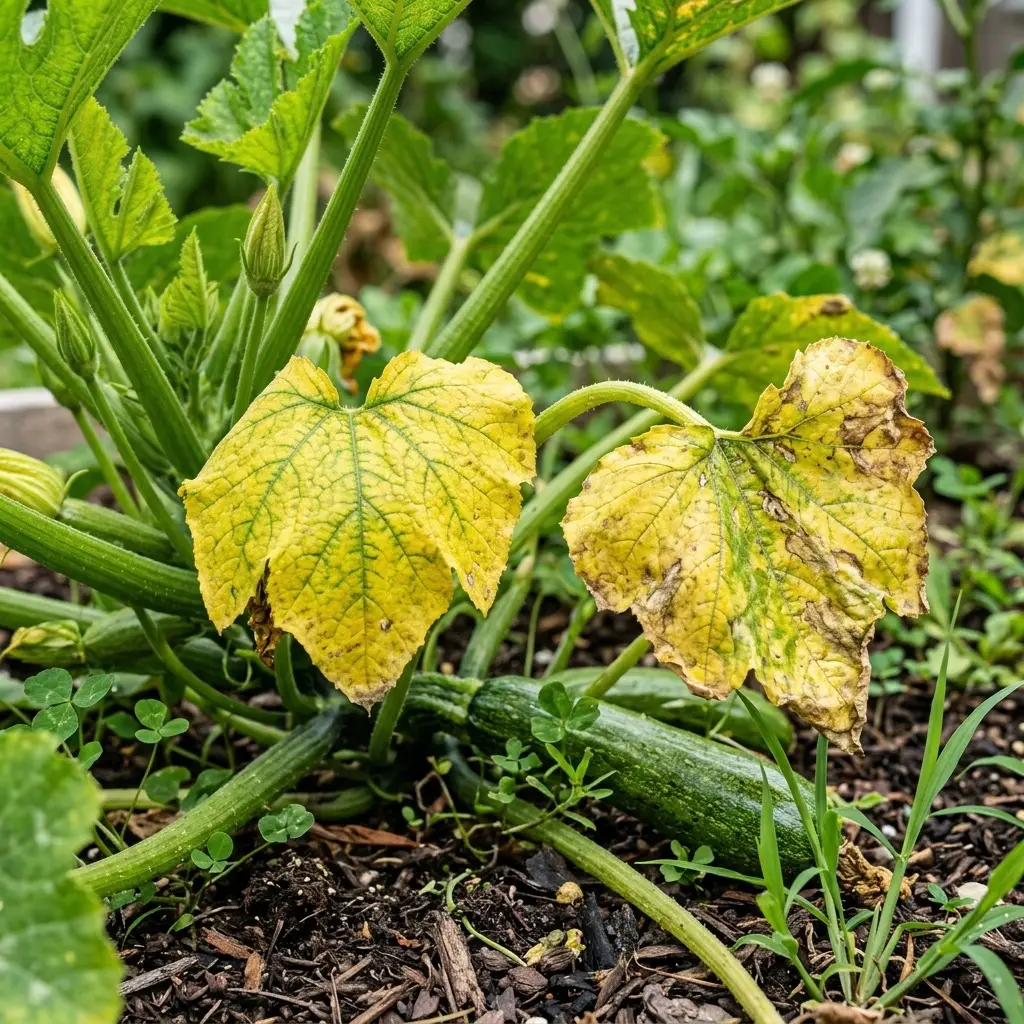
Yellow zucchini leaves are a symptom, not a death sentence. Work through these eight causes from most to least common and you will usually spot the problem fast — especially in a raised bed where you control the soil from the start.
Quick rule: Look at which leaves are yellowing and in what pattern. Location on the plant and the pattern of discoloration are your two best diagnostic clues.
1. Overwatering or Poor Drainage (the #1 Culprit)
Waterlogged soil forces oxygen out of the root zone. When roots cannot breathe, they cannot absorb nutrients — and the first sign is yellowing of the lower, older leaves. In a raised bed, this usually happens when:
- You water on a rigid schedule instead of checking soil moisture
- The bed lacks adequate drainage layers or uses heavy clay-heavy soil
- The bed bottom sits on compacted ground with no outlet
How to diagnose it: Push your finger two inches into the soil. If it feels wet or cold when it should have dried out since the last watering, you are overwatering. The leaves may also feel slightly limp during the day rather than crisp.
Fix: Let the top inch of soil dry between waterings. Water deeply and infrequently — two to three times per week in hot weather rather than a little every day. If your soil mix compacts quickly or holds water too long, work in perlite or coarse sand and add compost to improve structure. Make sure your raised bed has drainage holes or gaps at the base if you built it on a liner.
2. Nitrogen Deficiency
Nitrogen is the nutrient zucchini needs most — it drives the lush leaf growth this plant is famous for. When nitrogen runs low, the plant pulls it from the oldest leaves first and moves it toward new growth, so lower leaves yellow from the tip inward while upper leaves stay green.
How to diagnose it: Look for uniform pale yellowing that starts at the leaf tip and moves toward the petiole. If younger leaves are the same deep green and only older ones are affected, nitrogen is the most likely cause.
Fix: Top-dress with an inch of finished compost, apply a balanced granular fertilizer, or drench the root zone with diluted fish emulsion. A nitrogen-boosting feed shows results within a week. Avoid flooding the bed with nitrogen late in the season — it pushes leafy growth at the expense of fruit. For beginners setting up a new bed, see how to fill a raised garden bed with a nutrient-rich starting mix that reduces deficiency problems from day one.
3. Magnesium or Iron Deficiency
If the leaf tissue between the veins turns yellow while the veins themselves stay green — a pattern called interveinal chlorosis — you are dealing with a micronutrient issue rather than nitrogen.
- Magnesium deficiency shows on older leaves first. Magnesium is a core component of chlorophyll, so when it is low the tissue between veins fades to yellow or even brown.
- Iron deficiency shows on new, young leaves first. Veins stay vivid green while the surrounding tissue turns pale yellow or nearly white.
How to diagnose it: Both deficiencies are frequently caused by pH being too high (above 7.0), which locks nutrients in the soil even when they are present. Test your soil pH before adding any amendments. Outside of pH, a soil test will confirm actual nutrient levels.
Fix: If pH is off, adjust it first — acidifying amendments (sulfur, peat moss) will free up iron; lime will correct overly acidic conditions. For a confirmed magnesium deficiency, dissolve one tablespoon of Epsom salts in a gallon of water and drench the root zone. Do not apply Epsom salts without a confirmed deficiency — excess magnesium blocks calcium uptake. Use our soil calculator to estimate how much amendment you need for your bed volume.
4. Natural Aging of Lower Leaves
Not every yellow leaf signals a problem. As zucchini plants mature and set fruit, they redirect energy upward. The bottommost leaves — often partially shaded by the canopy and weeks old — naturally yellow, dry out, and drop.
How to tell it is normal: The plant is growing vigorously, fruit is setting, upper and middle leaves are deep green, and only the very lowest leaves are yellowing. There is no spot pattern, mildew, or rapid spread.
Fix: Nothing, except to remove the yellowed leaves cleanly so they do not trap moisture or harbor pests at soil level. This is normal senescence and does not require intervention.
5. Too Much or Too Little Sun
Zucchini needs full sun — at least six hours of direct sun per day, and preferably eight. In raised beds positioned in partial shade, plants may produce large, pale leaves that lack the deep green color of healthy foliage.
At the other extreme, in peak summer heat (sustained temperatures above 95°F), leaves can yellow and scorch at the edges — particularly if combined with inconsistent watering.
Fix: Site your raised bed where it receives morning sun and some afternoon shade in the hottest climates. Mulch the soil surface with two to three inches of straw or wood chips to keep the root zone five to ten degrees cooler and reduce evaporation. Water in the early morning so foliage dries before midday.
6. Pests — Squash Bugs and Vine Borers
Two pests cause yellowing that mimics nutrient deficiency:
- Squash bugs feed in clusters on leaf undersides, injecting a toxin that causes yellow patches, wilting, and eventually whole-leaf die-back. Look for flat, bronze-colored oval eggs stuck to leaf undersides in neat rows.
- Squash vine borers attack the main stem near the soil line. The first sign is sudden wilting of a large stem section, followed by yellowing of everything above the entry point. Look for sawdust-like frass at the base of the stem.
Fix: Check leaf undersides weekly starting when plants are young. Scrape off and destroy squash bug eggs before they hatch. For borers, use row covers until the plant begins to flower, then remove for pollination. Detailed removal steps are in how to get rid of squash bugs.
7. Disease — Powdery Mildew and Mosaic Virus
Powdery mildew is a fungal disease that first appears as white, powder-like patches on leaf surfaces. As it progresses, affected tissue yellows and dies. It thrives in humid conditions with poor airflow — exactly what a crowded raised bed can create.
Cucumber mosaic virus (which also infects zucchini) causes irregular yellow and green mottling across the leaf — not uniform yellowing. It spreads through aphids. There is no cure; remove and bag infected plants.
Fix for powdery mildew: Improve airflow by pruning overlapping leaves. Water at the base and never overhead. Treat early infections with a spray of one part milk to nine parts water, or use a potassium bicarbonate solution per label instructions. The same good practices that help prevent disease on pepper plants apply here — spacing, airflow, and dry foliage. For the full treatment and prevention plan, see our guide to powdery mildew on squash and zucchini.
Fix for mosaic virus: Control aphid populations (yellow sticky traps, insecticidal soap), remove infected plants promptly, and do not compost them.
8. pH Out of Range
Zucchini thrives at a soil pH of 6.0–7.0. Below 6.0, manganese and aluminum can reach toxic levels; above 7.0, phosphorus, iron, and several micronutrients become chemically unavailable even if they are physically present.
Fix: Test pH with a reliable meter or a mail-in soil test. Add agricultural lime to raise pH; add sulfur or acidifying fertilizer to lower it. For new raised beds, starting with a well-balanced mix (see how deep should a raised garden bed be for fill depth guidance) reduces the chance of pH problems in year one.
Diagnosis Flow
Run through these questions in order:
- Is the soil wet or soggy? → Fix drainage and watering frequency first.
- Are lower leaves yellowing uniformly from tip to base? → Nitrogen deficiency.
- Is the pattern interveinal (veins green, tissue yellow)? → Check pH, then check magnesium or iron.
- Only the very bottom leaves, plant otherwise thriving? → Normal aging.
- White powder on leaves? → Powdery mildew.
- Yellow patches with wilting, or frass at stem base? → Squash bugs or vine borer.
- Mottled yellow and green pattern? → Mosaic virus — remove the plant.
Work from the top of that list down. In a raised bed, overwatering and nitrogen issues resolve roughly 60–70% of yellowing cases — so start there before reaching for fungicides or micronutrient supplements.
Prevention in Raised Beds
Most yellowing traces back to soil and water. A free-draining soil mix and consistent (not constant) watering prevent the majority of cases. Space plants at least two to three feet apart so air circulates freely. Mulch the soil surface to moderate temperature and moisture. Do a soil test once a year to stay ahead of pH drift and nutrient depletion.
If you are new to raised beds, raised bed gardening for beginners covers the foundational setup steps that prevent most of these problems from the start. The same yellowing patterns show up in cucumbers — see why cucumber leaves turn yellow for a side-by-side comparison.
Still not sure what’s causing it? GardenGenius diagnoses yellow leaves from a photo and builds a watering schedule to stop the problem from coming back.
Frequently asked questions
Should I cut off yellow zucchini leaves?
Yes, once a leaf is fully yellow it will not recover. Remove it cleanly at the stem to improve airflow and prevent the spread of fungal disease. Leave any leaf that still has green tissue — it is still photosynthesizing.
How do I tell overwatering from a nutrient deficiency?
Stick your finger two inches into the soil. If it feels wet or soggy, overwatering is the likely culprit. If the soil is appropriately moist but lower leaves are yellowing from the tip inward, a nitrogen deficiency is more likely. A soil test confirms which nutrients are missing.
Is some yellowing of zucchini leaves normal?
Yes. The oldest, lowest leaves naturally yellow and die as the plant matures and redirects energy upward. This is normal senescence. It becomes a problem only when yellowing moves up the plant quickly, affects multiple layers at once, or is accompanied by spots, mildew, or wilting.
How do I fix a nitrogen deficiency in a raised bed?
Top-dress with an inch of finished compost, apply a balanced granular fertilizer, or drench the root zone with a diluted fish emulsion. Repeat in two to three weeks if new leaves still emerge pale. Avoid over-applying nitrogen late in the season, which promotes leaf growth at the expense of fruit.
Can yellowing zucchini leaves spread to other plants?
It depends on the cause. Fungal diseases like powdery mildew spread readily through air and water splash. Mosaic virus spreads via aphids. Nutrient deficiency and overwatering do not spread. Remove diseased leaves promptly, disinfect pruning tools between cuts, and keep foliage dry when watering.
Why are only the leaves between the veins yellow while veins stay green?
That pattern is called interveinal chlorosis and points to a micronutrient deficiency. On older leaves it is usually magnesium; on new growth it is usually iron. Both are most common when soil pH is too high, which locks nutrients out even when they are present in the soil. Test pH first before adding supplements.