By Azura · Updated July 2026 · Raised Garden Hub is reader-supported. When you buy through links on our site, we may earn an affiliate commission at no extra cost to you.
For a patio or balcony, verify load, runoff, wind, and building rules before buying a planter. Choose an elevated contained planter only after those checks; use a compact open-bottom frame for a small yard with suitable soil below. Skip a filled balcony bed when permitted load or drainage cannot be confirmed. Evidence and US product availability were checked July 29, 2026. This is research-based; we have not load-tested the recommended format.
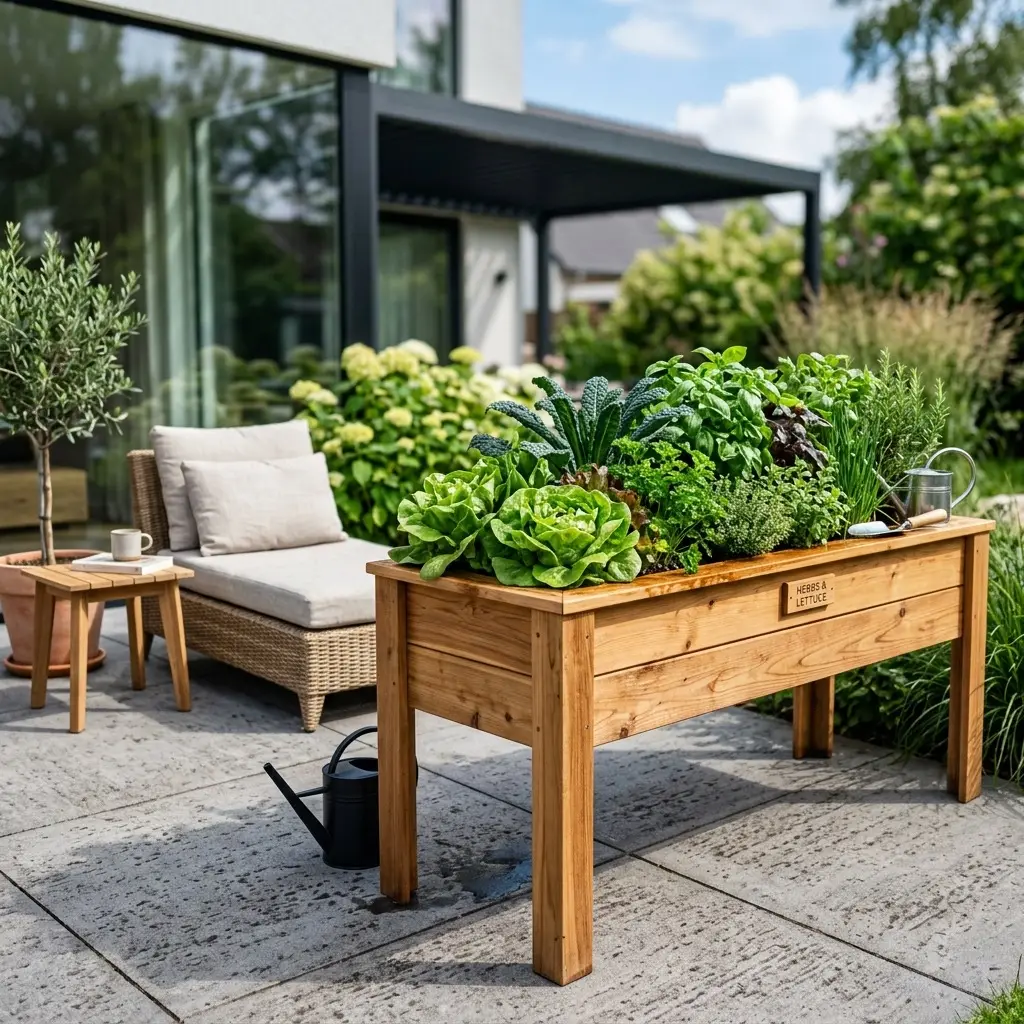
Elevated Raised Garden Planter
- Designed for hard-surface growing
- Raised working height
- Some models offer controlled drainage
- Compact footprint
- Contained depth varies by model and limits crop choice
- Check balcony weight limits before filling
Product facts are manufacturer- or retailer-published unless this page documents a Raised Garden Hub measurement. Confirm the exact model, live price, and terms before buying.
The real constraints of small-space gardening
Before picking a bed, get clear on three things: weight, drainage, and sun.
Weight matters most on balconies and rooftops. Saturated mix, the planter, stored water, plants, and people all contribute to the load. We do not publish a generic balcony capacity: confirm the permitted load and placement with the building owner, drawings, or a qualified structural professional before filling any planter.
Drainage needs a deliberate route on any hard surface. Choose manufacturer-designed outlets, confirm where runoff is permitted to go, and check that a tray can be emptied safely. Avoid modifying the planter unless the manufacturer permits it.
Sun can limit a balcony crop plan. Track direct light across the day and compare it with the seed or Extension guidance for the exact crop. Leafy greens often tolerate less sun than fruiting crops, but cultivar and local heat still matter.
Elevated vs. compact ground bed — which one to choose
The choice comes down to your surface and how deep your roots need to go.
Choose an elevated planter if:
- You’re gardening on a balcony, rooftop, patio, or deck with no soil access
- You want to avoid bending — elevated beds sit at roughly counter height
- You need drainage into a tray to protect the surface below
- You’re growing greens, herbs, and shallow-rooted crops
Choose a compact ground bed if:
- You have a small yard or garden bed and want to maximize root depth
- You’re growing peppers, tomatoes, root vegetables, or anything that benefits from 12+ inches of depth
- You prefer a coated-metal frame that avoids biological rot and routine sealing
- You want more total soil volume without a large footprint
For depth guidance, the how deep should a raised garden bed be guide covers the root requirements of common vegetables in detail.
Best for a patio or balcony — elevated planter
An elevated bed brings the garden up to standing height and sits on any hard surface. Look for a slatted or lined base so water drains into a tray, and check that the frame is powder-coated or made from rot-resistant material.
Elevated Raised Garden Planter
- Designed for hard-surface growing
- Raised working height
- Some models offer controlled drainage
- Compact footprint
- Contained depth varies by model and limits crop choice
- Check balcony weight limits before filling
Product facts are manufacturer- or retailer-published unless this page documents a Raised Garden Hub measurement. Confirm the exact model, live price, and terms before buying.
Quick verdict: After the surface load and drainage are verified, an elevated planter can be a practical choice for compact crops. Confirm the exact model’s filled weight and drainage design before ordering.
See our full guide to the best elevated raised beds for a deeper comparison of materials and brands.
Best for a small yard — compact metal bed
A compact ground bed can provide more root-zone volume than a shallow elevated planter while keeping the center reachable. Compare the exact coating, panel, brace, warranty, and inside dimensions rather than assuming metal has a fixed lifespan or universal safety advantage.
Vego Garden Compact Metal Raised Bed
- Contained root zone for many vegetables
- Coated metal avoids biological rot
- Tidy 2x4 or 3x3 footprint fits a corner
- Some models offer multiple layouts
- Needs ground or a very sturdy surface — not suitable for balconies
- Higher upfront cost than basic planters
Product facts are manufacturer- or retailer-published unless this page documents a Raised Garden Hub measurement. Confirm the exact model, live price, and terms before buying.
Quick verdict: For a small yard with usable soil below, a compact open-bottom frame can support a wider crop range than a shallow elevated planter. Service life still depends on the exact material, installation, and site.
Trying to decide what size to buy? The best size for a raised garden bed guide breaks down the tradeoffs between common dimensions.
What to grow in limited depth
Matching crops to the soil depth you actually have makes or breaks a small-space garden.
| Space / contained depth | Extension-listed crop or cultivar examples | Recommendation |
|---|---|---|
| Shallow herb/greens planter | leaf lettuce, spinach, Swiss chard, parsley | Use container mix, drainage, and close moisture monitoring |
| 2-gallon-class container | Little Finger, Danvers Half Long, Nantes Half Long carrots | Match container depth to mature root length |
| 5-gallon-or-larger tomato container | compact/patio tomatoes; Micro Tom for very small spaces | One plant per container; add cultivar-appropriate support |
| Compact ground bed | bush beans, peppers, greens, short carrots | Keep the bed reachable and use vertical support where appropriate |
Sources: Illinois Extension’s container crop/variety table, small-space cultivar examples, and University of Minnesota’s current five-gallon minimum for container tomatoes. Information checked July 29, 2026. Always verify balcony load capacity separately.
Use the seed packet’s mature spread and spacing rather than a universal square-foot promise. See raised-bed gardening for beginners for a planning walkthrough.
Patio and balcony tips that actually matter
Use a mix specified for the exact container and crop, not excavated garden soil by default. University of Minnesota recommends potting mix for container tomatoes, while other crops and self-watering systems can have different requirements. Compare the manufacturer’s mix guidance, wet weight, drainage, and local Extension advice; no label makes compaction or waterlogging impossible. Our soil guide explains the evidence limits.
Grow vertically where the crop supports it. A correctly rated trellis lets peas, some cucumbers, and indeterminate tomatoes use vertical space while keeping paths clearer. It can improve use of floor area, but final yield still depends on cultivar, light, root volume, water, fertility, and disease pressure.
Check moisture more frequently. Small beds and elevated planters can dry faster than larger ground beds. Water when the crop and root-zone moisture indicate it; do not use a fixed daily schedule without checking weather, mix, container volume, and drainage.
Pick cultivars labeled “compact” or “patio.” Seed packets and plant tags usually call these out. Compare mature spread, recommended container volume, support, and days to maturity rather than assuming every compact label guarantees a specific yield.
Place the bed where the sun actually is, not where you want it. It sounds obvious, but many balcony gardeners position beds near the door or railing for convenience, then wonder why nothing grows. Track the sun for a full day before you decide on placement.
How to grow more in a small bed
- Cultivar-based spacing uses the mature spread and seed/Extension guidance; a grid is only a layout aid, not permission to crowd plants.
- Grow up — trellis peas, cucumbers, and cherry tomatoes to save floor space and keep paths clear.
- Succession plant — when one crop finishes, replant only if the remaining local season, disease history, and nutrient plan support the next crop.
- Right depth and volume — use the crop/cultivar table above and the raised bed size calculator instead of a universal 8–12 inch rule.
- Plan the fill — use the soil calculator for base volume, then allow for headspace and settling with the filling guide.
Want a standard full-size bed instead? See the best raised garden beds of 2026 for a full roundup across all sizes. For a verified ground-level site, compare the complete frame, mix, delivery, tray, and irrigation cart in the raised-bed total-cost calculator. Do not use that estimate as a structural-load approval for a balcony.
Frequently asked questions
What is the best raised bed for a balcony?
After verifying the balcony's permitted load, drainage, wind exposure, and building rules, a compact planter with controlled drainage can work. Include the wet mix, planter, stored water, plants, and people in the load—not just the empty product weight.
What can you grow in a small raised bed?
Leaf lettuce, spinach, chard, herbs, short carrots, compact peppers, and patio tomatoes can fit small containers when the cultivar, container volume, drainage, and spacing match. Use the variety-specific table in this guide instead of a universal plants-per-square-foot promise.
Is an elevated bed better than a compact ground bed for small spaces?
It depends on the surface, verified load capacity, drainage, and crops. An elevated planter can suit a patio or balcony; a compact open-bottom ground bed gives roots access to native soil in a small yard. Do not assume a balcony can carry any filled bed—confirm limits with the building owner or a qualified professional.
How small is too small for a raised garden bed?
There is no universal minimum footprint. A 2x2 bed can grow several compact crops; a 2x4 bed provides more rotation and support options. Choose from the mature spread, root volume, access path, and verified surface load rather than an arbitrary cutoff.
How do I handle drainage on a patio or deck?
Choose a planter with manufacturer-designed outlets and a runoff plan that complies with building rules. A tray can help only if it is sized and emptied safely. Do not drill or line a structural planter unless the manufacturer permits it; modifications can damage the product or void its warranty.
What size raised bed should I choose for a small yard?
Measure the access path and reach before choosing. A 2x4 or 3x3 format can fit many small yards, but crop spread, support, and irrigation decide suitability. Keep the center reachable from the available sides; four feet is a common maximum only when both long sides are accessible.