By Azura · Updated July 2026 · Raised Garden Hub is reader-supported. When you buy through links on our site, we may earn an affiliate commission at no extra cost to you.
For tomatoes, the Vego 17-inch format is the ecosystem pick when its delivered price, configuration, warranty, and support accessories fit. A 12-inch open-bottom bed can work over usable soil; plan about 18 inches of contained mix on hardscape. Skip the premium frame when an existing reachable bed already provides the root volume and support plan. Evidence and US product availability were checked July 29, 2026. This is research-based; we have not run a tomato yield or soil-temperature trial.
Vego Garden 17in 9-in-1 Modular Metal Raised Bed
- 17in contained root zone
- Published 0.6 mm coated-steel panels
- Multiple configurations
- Compatible support accessories
- Premium price
- Needs plenty of soil to fill
Product facts are manufacturer- or retailer-published unless this page documents a Raised Garden Hub measurement. Confirm the exact model, live price, and terms before buying.
If you’re planning your full tomato-growing setup from soil prep to harvest, our complete guide to how to grow tomatoes in raised beds walks through every step. This post focuses specifically on choosing the right bed.
Root volume matters more than wall height alone
Very shallow contained planters hold less water and give roots less volume, but an open-bottom bed can use suitable soil below the frame. The practical risks of too little total root volume are:
- Smaller plants that dry out faster between waterings
- Plant stress when the container repeatedly dries between irrigation checks
- Higher risk of blossom-end rot — which is tied to inconsistent water and calcium uptake, both of which worsen in shallow soil
A larger contained root volume can buffer moisture better than a very small container when the mix and drainage are comparable, but it still needs monitoring. A self-watering raised bed can reduce watering swings only when its reservoir, overflow, and soil wicking are correctly set up.
Variety, space, and bed recommendation
| Tomato habit | Examples | Practical bed/container plan | Spacing and support |
|---|---|---|---|
| Dwarf / patio | Pixie, Patio, Micro Tom | Large container (at least 5 gal) or 12 in+ bed | Follow the label; compact cage or stake |
| Determinate / bush | Roma, Celebrity, Super Bush | 12 in+ open-bottom bed; ~18 in contained mix on hardscape | About 18–24 in; sturdy cage |
| Indeterminate / vining | Sungold, Cherokee Purple, Brandywine | 12 in+ open-bottom bed; ~18 in contained mix on hardscape | About 24–36 in; tall stake, cage, or trellis |
Sources: Illinois Extension’s tomato habit and spacing guidance, University of Minnesota Extension’s tomato guide, and University of Maryland Extension’s 18-inch container-depth guidance. Information checked July 29, 2026. Bed-depth entries are our site-planning recommendations, not trial-proven yield thresholds.
Our raised-bed size guide covers depth, width, access, and the surface below the bed.
Not sure how to calculate volume for filling a tall bed? Our soil calculator does the math for you.
Why width matters too
Keep beds 4 feet wide or narrower. Tomatoes need staking, pruning, and regular inspection. If you can’t reach the center of the bed from either side without stepping in, you’ll compact the soil around roots — exactly what you’re trying to avoid by using a raised bed in the first place.
Length is flexible. A 4×4 or 4×8 bed are both common. Use our raised bed size calculator to match your space to the number of plants you want to grow.
Metal vs. wood for tomatoes
Both materials work well. Here’s how they compare for tomato growing specifically:
- Metal (galvanized or zinc-aluminum-magnesium-coated steel): Does not biologically rot, but scratches, cut edges, soil chemistry, and warranty terms still matter.
- Cedar or redwood: Naturally decay-resistant and easy to cut or repair, but still biodegradable in wet soil contact.
- Pine or spruce: Lower upfront cost and easier DIY construction, with faster decay than cedar/redwood in the same conditions.
Choose metal when modular configuration and lower frame maintenance suit the project; choose wood when cut-to-fit repairability matters. We have not run a controlled temperature or assembly test. For current product facts, see Vego vs Vegega or the best raised garden beds roundup.
Best bed for tomatoes — tall metal
A 17-inch or taller metal bed gives tomato roots room without requiring any carpentry.
Vego Garden 17in 9-in-1 Modular Metal Raised Bed
- 17in contained root zone
- Published 0.6 mm coated-steel panels
- Multiple configurations
- Compatible support accessories
- Premium price
- Needs plenty of soil to fill
Product facts are manufacturer- or retailer-published unless this page documents a Raised Garden Hub measurement. Confirm the exact model, live price, and terms before buying.
Quick verdict: Vego 17” is the ecosystem pick when you value multiple configurations and compatible support accessories. Its 20+ year service-life statement is a manufacturer claim; its current written limited warranty is two years.
Spacing and how many tomatoes fit
Getting spacing right is as important as bed size. Crowding can reduce airflow and complicate inspection, watering, and support.
- 4×4 bed: 2 indeterminate (vining) tomatoes with tall cages, or 3–4 determinate (bush) types
- 4×8 bed: 4 indeterminate tomatoes, or 6–8 determinate types
- General rule: Allow roughly 18–24 inches between determinate varieties and 24–36 inches between indeterminate varieties
For a deeper look at spacing across all vegetables, the raised bed plant spacing chart covers exact numbers by plant type.
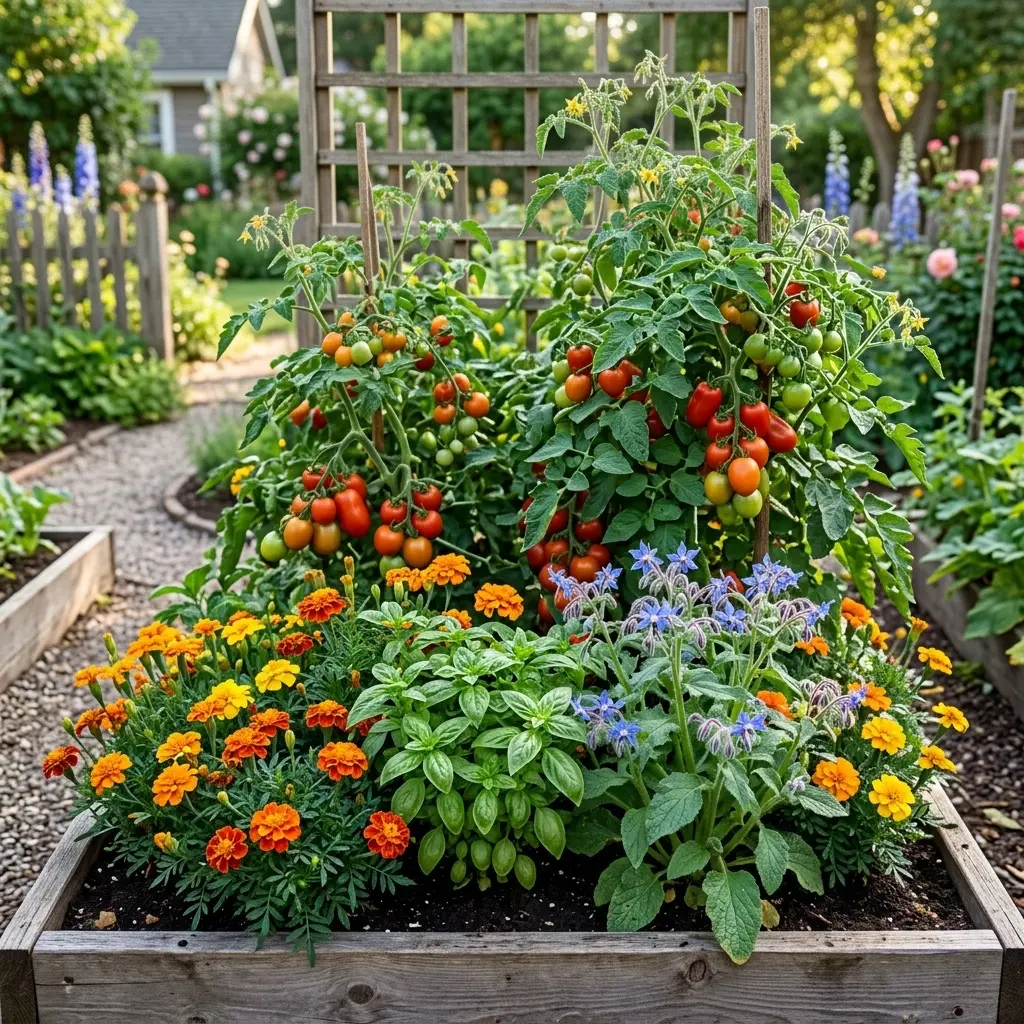
Use compatible low-growing plants between supports only where they do not reduce airflow or compete for water. Our companion plants for tomatoes guide separates practical space-sharing from unsupported flavor or pest-control promises.
Choosing indeterminate vs. determinate for your bed size
This choice matters a lot in a raised bed, where space is defined and finite:
- Indeterminate varieties (Sungold, Cherokee Purple, Brandywine, most heirlooms) keep growing and producing all season until frost. They need tall, sturdy support — plan for 5–6 ft cages or rebar stakes. Best in a 4×8 or longer bed where you have room for supports and good airflow.
- Determinate varieties (Roma, Celebrity, Bush Early Girl) stop at a predictable height (usually 3–4 ft) and ripen most of their fruit in a concentrated window. Great for a 4×4 bed, for canning, or when you want less ongoing pruning. They still benefit from staking but are far more forgiving about tight spacing.
Soil and care tips tied to bed choice
The right bed is only half the equation. What goes inside — and how you manage it — determines whether your tomatoes thrive.
Soil mix: Penn State Extension suggests about 70% quality soil and 30% compost for raised beds; Oregon State advises up to 25% compost by volume. Use a soil test and locally appropriate mineral soil instead of assuming one ratio fits every source material. See our best soil mix guide.
Very tall beds can use a lower organic-fill layer as a cost-saving scenario, but it decomposes and settles. Keep an adequate mineral-soil-and-compost root zone above it, and use the soil calculator with the exact fill depth.
Watering: Check moisture in the active root zone and adjust to weather, plant size, mix, and drainage rather than using one weekly amount. Drip or a soaker hose can help apply water consistently, but the schedule still needs observation. Moisture swings can contribute to blossom-end rot.
Mulch: Apply an appropriate organic mulch after plants establish to reduce evaporation and soil splash. Keep it away from the stem and monitor moisture below the mulch; we have not measured a universal temperature reduction for these beds.
Calcium and watering consistency: Blossom-end rot involves calcium transport and inconsistent moisture. Do not add lime or calcium blindly; test the soil first, then follow the lab recommendation. See our blossom-end rot guide.
Staking and support: Install a cultivar-appropriate cage, stake, or trellis at planting time. Anchor it to the bed or ground according to its instructions and local wind exposure; loose growing mix alone is not proof of storm resistance.
Fertilizing: Use a soil test and the local tomato recommendation. Avoid a fixed compost depth, tea, or every-3–4-weeks schedule that ignores the existing nutrient level and fertilizer label.
Crop history: Record where tomatoes and related crops grew, rotate where space allows, remove diseased debris, and follow local guidance for any diagnosed soil-borne disease. Rotation is useful but is not a universal cure or a substitute for diagnosis.
Quick checklist
- 4 ft wide or less; 12 in+ open-bottom or about 18 in contained mix on hardscape
- Full sun — at least 6 hours, 8 preferred
- Soil-test-guided mineral soil and finished compost — our best soil mix guide covers options
- 18–24 inches between plants depending on variety; indeterminate types need 24–36 inches
- Stake or cage early — do it at transplant time, not after the plant flops over; plan for 5–6 ft supports
- Mulch and consistent moisture management to reduce stress; neither guarantees disease prevention
- Add companion crops only where they preserve airflow and water access — see companion plants for tomatoes
- Use the soil calculator for base volume before headspace and settling
Then compare the frame, soil, delivery, trellis, irrigation, mulch, and cover in the raised-bed total-cost calculator. The cheapest frame can produce the more expensive installed tomato system.
Frequently asked questions
How deep should a raised bed be for tomatoes?
A 12-inch open-bottom bed can work over loose native soil; use roughly 18 inches of contained growing mix on concrete or another hard surface. The 18-inch contained recommendation aligns with University of Maryland Extension's container guidance, but it is a planning recommendation rather than a cultivar-specific hard minimum.
How many tomatoes can I grow in a 4x4 raised bed?
The count depends on cultivar habit and support. A conservative layout is 1–2 indeterminate plants or up to 4 compact determinate plants in a 4x4 bed, provided the Extension or nursery spacing still fits. Airflow reduces disease risk but does not prevent disease.
What size raised bed is best for tomatoes?
A 4x4 or 4x8 ft bed no wider than 4 feet is easy to reach from both sides. Use 12 inches or more over usable native soil, or about 18 inches of contained growing mix on hardscape, then space plants by growth habit and support system.
What should I plant with tomatoes in a raised bed?
Use lower crops only where they do not crowd tomato roots, block airflow, or compete for water. Basil, lettuce, green onions, or flowers can share edge space, but companion planting does not replace spacing, crop rotation, irrigation, or pest monitoring.
Do tomatoes need a deep raised bed?
Tomatoes need enough root volume, drainage, and steady moisture, but bed-wall height alone does not predict yield. A 12-inch open-bottom bed can use the soil below; a hard-bottom or patio setup needs a deeper contained mix.
Is metal or wood better for growing tomatoes in a raised bed?
Both can work. Choose by coating or wood species, drainage, bracing, repairability, and budget. We have not run a controlled metal-versus-wood soil-temperature test, and there is no universal lifespan winner for every product and site.
Should I use indeterminate or determinate tomatoes in a raised bed?
Both work, but your bed size and support setup should guide the choice. Indeterminate (vining) varieties like Cherokee Purple, Sungold, or Brandywine keep growing all season and need 5–6 ft cages or stakes — great for a 4x8 bed where you have room to spread supports. Determinate (bush) varieties like Roma or Celebrity stop at a set height, need minimal caging, and pack better into a 4x4 bed. Mix both if you have a long bed and want a steady supply.
What kind of cage or stake works best for tomatoes in a raised bed?
Match support to the cultivar's mature habit. Indeterminate tomatoes need a tall, securely anchored cage, stake, or trellis; determinate types still benefit from support. Install it at planting time and follow the support manufacturer's anchoring instructions for your bed and wind exposure.