By Azura · Updated June 2026 · Raised Garden Hub is reader-supported. When you buy through links on our site, we may earn an affiliate commission at no extra cost to you.
Tomatoes grow better in raised beds than in the ground — warmer soil, better drainage, and fewer soil-borne diseases. The key is planting deep, spacing for airflow, installing support at planting, and watering consistently.
Raised beds solve the two biggest obstacles to tomato success: poor soil and poor drainage. In the ground, clay soil compacts around roots; sandy soil drains too fast. A raised bed gives you a controlled growing environment from day one — and tomatoes reward that with bigger harvests and fewer problems.
Why raised beds are ideal for tomatoes
Raised bed advantages apply to every crop, but tomatoes benefit more than most:
- Warmer soil. Raised beds warm 2–4 weeks ahead of in-ground soil in spring. Tomatoes stop growing below 55°F, so earlier warm soil means earlier planting and a longer harvest window.
- Better drainage. Tomatoes hate wet feet. The root zone needs oxygen, and raised beds provide drainage that most native soils can’t.
- Fewer soil-borne diseases. Fusarium wilt, verticillium wilt, and early blight persist in native soil. Fresh raised bed mix contains none of these pathogens.
- Easy rotation. Disease management requires moving tomatoes to different soil each year. In raised beds, you simply plant them in a different bed.
Choosing the right bed
Depth matters most. Tomato roots go down. In a 6-inch bed, they hit the subsoil within weeks. A 12-inch bed works, but plants will be less vigorous. 18 inches lets tomatoes develop the root system they need for heavy fruit production.
For depth recommendations by crop, see how deep a raised garden bed should be.
Size. A 4×8 bed comfortably fits 3–4 indeterminate tomatoes at 24 inches apart, or up to 6 compact bush varieties at 18 inches. Leave room — tomatoes need airflow to prevent fungal disease, and you need to reach every plant without stepping in the bed.
Material. Metal beds heat up faster in spring (good) but can warm soil edges in extreme summer heat. Cedar insulates better. The soil quality matters far more than the frame material. See metal vs. wood raised garden beds for a side-by-side.
Soil preparation
Fill with a rich, loose, well-draining mix: one-third mature compost, one-third peat moss or coco coir, one-third coarse perlite or vermiculite.
Before transplanting, mix in per plant location:
- 2 tablespoons slow-release balanced fertilizer (10-10-10)
- A handful of bone meal (supports root and flower development)
- Crushed eggshells or lime if pH is below 6.0 (aim for 6.2–6.8)
For a full soil guide, see best soil mix for raised garden beds.
When to transplant
Transplant after:
- Your last frost date has passed
- Night temperatures stay consistently above 50°F
- Daytime temperatures are 65–85°F
Planting too early stunts tomatoes — cold soil slows root development even when air temperatures look fine.
How to plant
Tomatoes root along their buried stems. Plant deep. Remove the lower two-thirds of leaves and bury that length of stem — either straight down in a deep hole, or diagonally in a shallow trench with the top bent upward. A tomato with 6 inches of stem buried underground develops roots along that entire length, producing a larger, more resilient plant.
Space by type:
- Indeterminate (vining): 24 inches minimum
- Determinate (bush): 18–24 inches
- Compact/patio: 12–18 inches
Support — install at planting
Install cages, stakes, or a trellis at planting time, before the roots spread. A cage driven in later will cut through established roots.
Heavy-gauge wire cages handle large indeterminate tomatoes better than the flimsy conical cages sold at most garden centers. Concrete-reinforcing wire cut into cylinders is the classic DIY option.
Stake-and-weave is the most space-efficient system: drive stakes between plants, weave string between them at 8-inch intervals as the plant grows. Works well in rows of 3+ plants in a raised bed.
Watering
Tomatoes need consistent, deep watering. Irregular moisture — wet then dry — causes blossom end rot, fruit cracking, and poor pollination.
How much: Water until drainage appears at the bed bottom. For a 4×8 bed at 18 inches deep, this is typically 4–6 gallons per session.
How often: Every 2–3 days in moderate weather; daily or every other day during heat waves. Check the top 2 inches — water when they feel dry.
How to water: Drip irrigation or soaker hoses are ideal. Overhead watering wets foliage and promotes disease. If hand watering, keep water at the base and avoid soil splash onto lower leaves.
Mulch is essential. Two to three inches of straw or shredded leaves on the soil surface cuts watering frequency in half, moderates soil temperature, and reduces the soil splash that spreads disease. Apply right after transplanting.
For a seasonal watering guide, see how often to water a raised garden bed.
Feeding
Before flowering: A balanced fertilizer (10-10-10) or compost every 3–4 weeks supports leafy growth and root development.
Once flowers appear: Switch to a lower-nitrogen formula (5-10-10 or a tomato fertilizer). High nitrogen at this stage produces beautiful foliage and almost no fruit. Phosphorus and potassium drive flower set, fruit development, and disease resistance.
Liquid fertilizer applied every 2 weeks from first flower through harvest keeps production steady.
Managing suckers (indeterminate varieties)
Suckers grow in the V-joint between the main stem and a branch. Left to grow, they become full branches and the plant becomes a dense, fruiting jungle. Pinching suckers on indeterminate tomatoes improves airflow, keeps the plant manageable, and directs energy into existing fruit.
Remove suckers when under 2 inches — pinch off by hand. Use clean scissors for larger ones (disinfect between plants to avoid spreading disease).
Determinate tomatoes: Don’t prune heavily. They set all their fruit at once and extra growth contributes to total yield.
Common problems
Blossom end rot — dark sunken patch at the bottom of the fruit. Caused by inconsistent watering blocking calcium uptake. Fix: mulch heavily, water consistently, avoid high-nitrogen fertilizer. Full guide: blossom end rot in tomatoes.
Tomato leaves curling — inward curl on lower leaves is usually watering stress; upward cupping on upper leaves can indicate mosaic virus. See why tomato leaves curl.
Not flowering — too much nitrogen, temperatures above 85°F at night, or not enough light. See tomato plants not flowering.
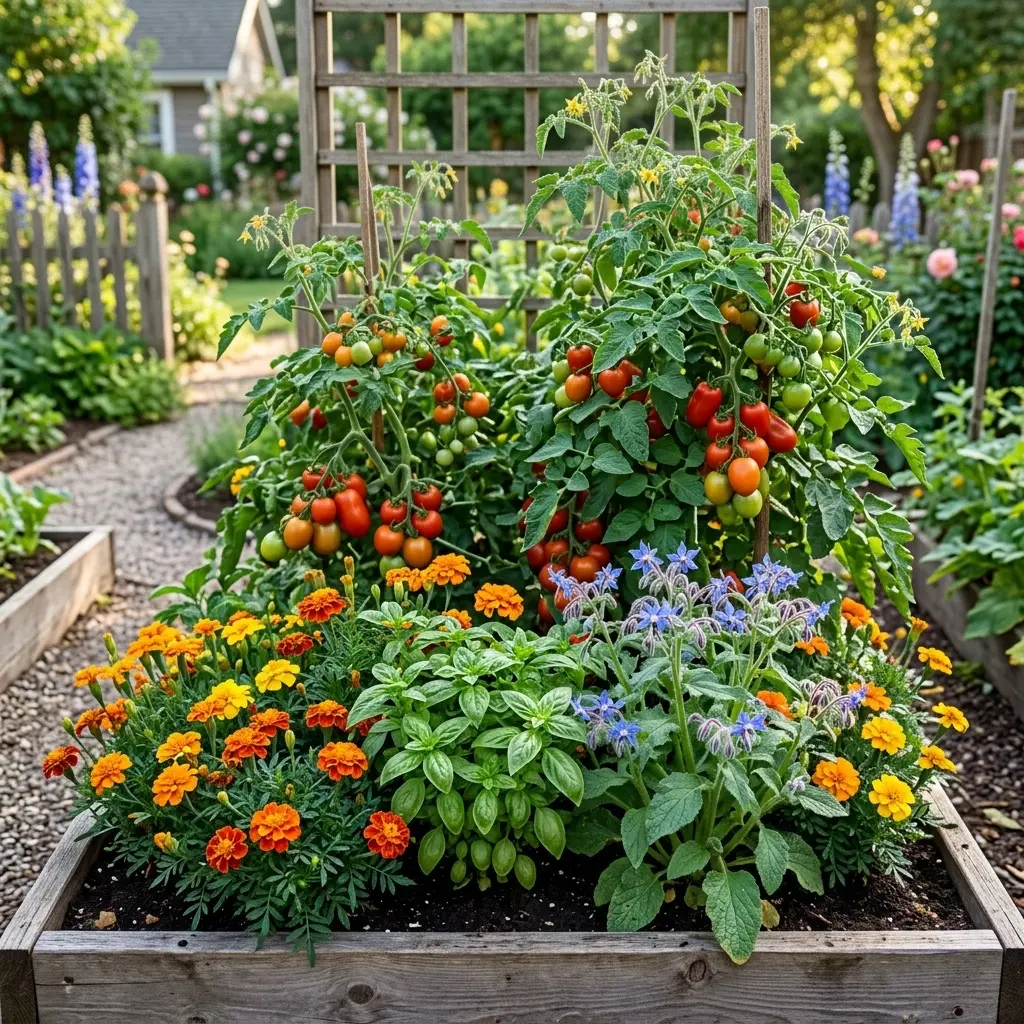
Companion planting reduces pest pressure and improves pollination. Basil, marigolds, and borage are excellent tomato companions. See companion plants for tomatoes.
Harvesting
Tomatoes are ready when they reach their variety’s mature color and give slightly to gentle pressure. Pick slightly early and let them ripen on a countertop — birds, insects, and splitting are all more likely at full vine ripeness. Refrigeration destroys tomato flavor.
Harvest frequently. Regular picking signals the plant to produce more fruit.
Extending the season
A row cover or cloche can add 2–4 weeks at both ends of the season. At season end, harvest everything even slightly colored — green tomatoes ripen on a countertop. Remove the entire plant; don’t leave tomato vines in the bed over winter, as disease spores overwinter on plant debris.
For help picking the right bed for tomatoes, see our roundup of the best raised garden beds for tomatoes.
Frequently asked questions
How many tomato plants fit in a 4x8 raised bed?
A 4×8 raised bed fits 4 to 6 tomato plants depending on variety. Indeterminate (vining) tomatoes need 24 inches per plant — 3 to 4 plants down an 8-foot bed. Determinate (bush) varieties can go 18 inches apart, fitting up to 6. Don't pack in more — crowded tomatoes produce less and get more disease.
What depth raised bed do tomatoes need?
Tomatoes need a minimum of 12 inches of soil depth, but 18 inches is significantly better. Deeper soil supports stronger root development, retains more moisture between waterings, and keeps plants more resilient during heat waves. In a 12-inch bed, indeterminate tomatoes can hit the bottom and become root-bound by midsummer.
What soil is best for tomatoes in a raised bed?
Tomatoes thrive in a loose, well-draining mix rich in organic matter: one-third compost, one-third coco coir or peat, and one-third coarse perlite. Work in a slow-release balanced fertilizer before planting. Tomatoes are heavy feeders and prefer a soil pH of 6.2 to 6.8.
How often should I water tomatoes in a raised bed?
Water tomatoes deeply every 2 to 3 days in warm weather — more during heat waves. Aim for consistent moisture, not wet-and-dry swings. Inconsistent watering is the primary cause of blossom end rot and fruit cracking. Mulch the soil surface and consider drip irrigation for best results.
Do tomatoes in raised beds need extra fertilizer?
Yes. Tomatoes are heavy feeders. Use a balanced fertilizer before planting, then switch to a lower-nitrogen, higher-phosphorus formula (5-10-10) once flowers appear. Excess nitrogen after flowering produces lush foliage but little fruit. Liquid fertilizer applied every 2 weeks from first flower to harvest maintains steady production.
What are the best tomato varieties for raised beds?
Cherry varieties — Sungold, Sweet Million, Black Cherry — are the most productive and forgiving in raised beds. For slicing tomatoes, Celebrity and Mountain Fresh are reliable disease-resistant picks. In small beds, choose determinate (bush) varieties that stop at 3 to 4 feet rather than indeterminate ones that reach 6 to 8 feet.
Why are my raised bed tomatoes getting blossom end rot?
Blossom end rot is caused by inconsistent watering blocking calcium uptake at the fruit — not usually a calcium shortage in the soil. Irregular wet-dry cycles are the trigger. Fix it by mulching heavily, watering consistently (drip irrigation helps), and avoiding excess nitrogen fertilizer.