By Azura · Updated June 2026 · Raised Garden Hub is reader-supported. When you buy through links on our site, we may earn an affiliate commission at no extra cost to you.
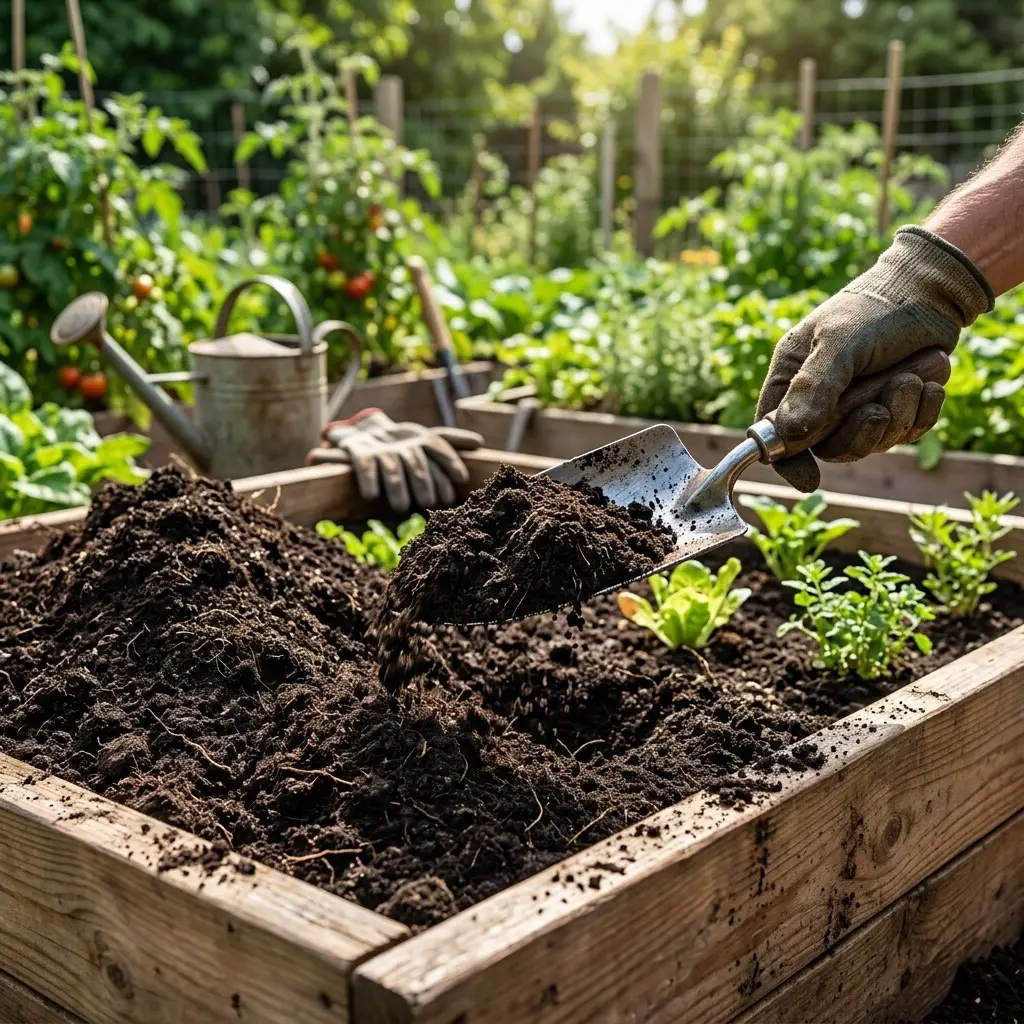
No-dig gardening means you never turn the soil — you add compost on top and let worms do the work. In a raised bed it’s the easiest, healthiest way to garden: fewer weeds, richer soil, and less effort every season. Here’s how it works and why it matters.
The core principle: don’t disturb soil life
Healthy soil is not just dirt. It’s a living system packed with bacteria, fungi, earthworms, and millions of organisms you can’t see. That network breaks down organic matter, moves water, and delivers nutrients to your plant roots. Every time you dig, you shred fungal threads, expose organisms to air, and scramble the layers that took years to form.
Digging also:
- Brings buried weed seeds to the surface where light triggers germination.
- Releases stored carbon as the disrupted organic matter oxidizes into CO₂.
- Dries out the soil by exposing moist lower layers to sun and wind.
- Collapses soil structure, creating hard, compacted layers below where you tilled.
The no-dig approach, popularized by growers like Charles Dowding over decades of market garden practice, works with the soil instead of against it. You add fertility from the top — exactly the way a forest floor works — and let biology carry it down.
Rule of thumb: If you can push a finger 3–4 inches into your bed soil without resistance, it’s loose enough. You don’t need to dig to loosen it further — worm activity and annual compost additions will keep it that way.
Why raised beds are the perfect home for no-dig
No-dig works in any garden, but raised beds make it even easier. Because you access the bed from the sides, you never step on the growing area. No foot traffic means no compaction. The soil stays naturally loose without any mechanical help.
Compare that to an in-ground garden vs. a raised bed: in the ground you’re often fighting compaction from walking nearby, heavy clay, or roots from surrounding trees. In a raised bed you control the soil from day one, and you never undo your own progress.
If you’re still figuring out what goes inside, start with a good soil mix for raised garden beds — the right foundation makes no-dig even more effective.
How to start a no-dig raised bed
Over existing grass or weeds
You don’t need to strip the ground. Follow these steps:
- Lay cardboard directly over the grass or weeds. Overlap the sheets by 6 inches so nothing creeps through the gaps. Remove any tape or staples first. Wet the cardboard thoroughly — this speeds breakdown and keeps it from blowing away.
- Add 4–6 inches of compost on top of the cardboard. This is your growing medium for the first season. Use aged compost or a quality garden mix — not bark mulch, which is too coarse for planting into directly.
- Plant straight into the compost the same day if you want. No tilling, no waiting, no mixing. Seedlings and transplants establish quickly in fresh compost.
The cardboard smothers whatever is underneath, breaks down over several months, and earthworms move through it as it softens. By the end of your first season, you won’t find cardboard anymore — just rich, loose soil.
For more detail on the layering approach, see the hügelkultur raised bed guide which uses a similar smothering technique but adds woody material underneath for long-term fertility.
Setting up a new empty bed
If you’re filling a brand-new frame, the steps are simpler:
- Line the bottom with cardboard to suppress any weeds growing up from below — more on that in what to put at the bottom of a raised garden bed.
- Fill the bed with your soil mix.
- Top with 1–2 inches of compost as a mulch layer.
- Plant and don’t dig again.
Use the soil calculator to figure out exactly how much fill and compost you need before ordering.
Annual compost mulching: the only maintenance
Once your bed is established, no-dig maintenance is simple: once a year, usually in early spring or late autumn, add 1–2 inches of fresh compost across the entire surface. You can plant into it immediately or let it sit over winter as a protective mulch.
That top dressing does several jobs at once:
- Feeds soil organisms that feed your plants.
- Smothers germinating weed seeds with a dense, light-blocking layer.
- Locks moisture into the soil so you water less in dry spells.
- Slowly builds organic matter depth year after year.
You don’t need to work the compost in. Earthworms pull it down within weeks. By mid-season it integrates naturally and the cycle starts again.
Weed, water, and time benefits
The weed reduction alone is enough reason to switch. In a freshly dug bed, every turning event brings dormant seeds to the surface. Studies on seed banks show soil can hold thousands of weed seeds per square foot at varying depths. Stop digging, stop surfacing them.
The compost mulch adds a second line of defense: seeds that blow in from outside can’t get the direct soil contact they need to root well, and the dense surface blocks light from the tiny seeds that do land. You’ll still pull occasional weeds — especially wind-dispersed types — but the workload drops sharply compared to a conventionally dug bed. Pair this with the strategies in how to keep weeds out of raised beds for the best results.
Water savings are a real benefit too. Undisturbed soil retains moisture better because the structure — those pore spaces, fungal threads, and worm channels — acts like a sponge. You may find yourself watering less frequently after the first season.
Time is the hidden bonus. Digging a 4×8 raised bed by hand takes real effort. Doing it every spring adds up. No-dig removes that task permanently. Spreading an inch of compost takes minutes.
Common mistakes to avoid
Using bark mulch instead of compost. Bark is fine as a path covering but it’s too coarse and carbon-heavy to use as your growing surface. Stick to aged compost or a screened garden mix.
Adding too little compost. One thin layer won’t suppress weeds or add meaningful fertility. Aim for at least 1 inch as an annual top-up, and 4–6 inches when you’re first establishing over grass.
Forking the soil “just this once.” It’s tempting, especially when you want to loosen a spot that feels hard. Resist it. If a small area feels compacted, investigate why — usually it’s poor drainage or a lack of organic matter — rather than digging, which just resets your weed clock.
Leaving the surface bare over winter. An uncovered bed loses moisture, erodes in rain, and leaves weed seeds no competition. Apply your annual compost layer in autumn and let it sit.
How no-dig fits into a larger raised-bed system
No-dig is a method, not an isolated trick. It works best when you’re also thinking about what you put in the bed, how you space plants, and how you manage the edges.
If you’re new to raised beds entirely, the raised bed gardening for beginners guide covers the full setup — from choosing a frame to filling it correctly — and no-dig fits naturally into that workflow. Once your bed is running well, how you fill it initially determines how quickly the no-dig method takes hold.
The short version: get your fill right once, top-dress with compost every year, and stop digging. Your soil will improve every season with almost no extra work.
Frequently asked questions
What is no-dig gardening?
No-dig (or no-till) gardening means you never dig or turn the soil. Instead you add a layer of compost on top each year and let worms and soil life work it in. It protects the soil structure, keeps carbon and moisture in, and brings far fewer weeds.
Why is no-dig better for raised beds?
Raised beds are ideal for no-dig because you never walk on the soil, so it stays loose. Digging brings buried weed seeds to the surface and damages soil life — skipping it means fewer weeds, healthier soil, and less work.
How do you start a no-dig raised bed?
Lay cardboard over grass or weeds, then add 4–6 inches of compost on top, and plant straight into it. Each following season, top up with 1–2 inches of fresh compost. No digging required.
Do you ever need to dig with the no-dig method?
Rarely. You might use a narrow tool to make a planting hole or loosen a single spot where roots have compacted. But routine digging, turning, and tilling are never needed. The soil stays loose because worms and biology do that work for you.
How does no-dig compare to hügelkultur?
Both methods build soil without tilling. Hügelkultur buries logs and organic matter below the surface to create a long-term nutrient reservoir, then adds compost on top. No-dig skips the buried layer entirely and relies only on surface compost additions. Hügelkultur takes more setup but generates more internal heat and moisture over years. No-dig is simpler and works well in standard raised beds.
Does no-dig really stop weeds?
It significantly reduces them. Digging brings dormant weed seeds from deep in the soil up to the light where they germinate. When you stop digging, those seeds stay buried. A thick compost layer also blocks light from reaching any weed seeds already on the surface. You will still get some wind-blown weeds, but far fewer than a dug bed.